

For Women’s History Month we’re doing a deep dive into some of the content you can find in the Library’s new resource: Bloomsbury Global Encyclopedia of Women in Architecture.
Shut out and hidden
Architecture first became a recognised profession in the UK in 1834 with the founding of the Royal Institute of British Architects (RIBA). Women were excluded from this for 64 years and it wasn’t until 1898 that Ethel Charles became the first woman admitted into RIBA. In post-war Britain, women who did enter the field were often buried inside husband-and-wife practices, their names absent from the door. MJ Long spent decades on the British Library alongside her husband Colin St John Wilson, but the practice bore only his name. Patty Hopkins co-designed the Glyndebourne Opera House under “Michael Hopkins and Partners.” And as the years went on, the gender gap in architecture was still massive. In 1989 there were only 2,502 women registered as architects compared to 25,293 men.
A radical critique of manmade architecture
The Matrix Feminist Design Co-operative was founded in 1980 by Fran Bradshaw, Anne Thorne, Sue Francis, and Barbara Macfarlane. Matrix was created in response to the male-dominated discussions of the New Architecture Movement. For Matrix, it was not sufficient to simply have more women in the profession, what was needed was a radical critique of the profession itself. And that’s exactly what they did in their book Making Space: Women and the Manmade Environment (1984). They challenged the supposedly gender-neutral design philosophies of the time which were in fact “manmade”—built, designed, and financed by men.
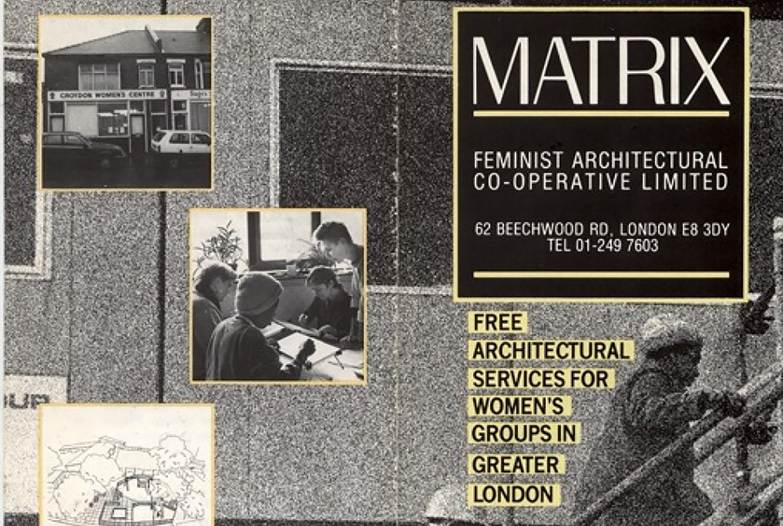
It was through these challenges and critiques that Matrix developed participatory design practices which were more inclusive and community led. On their first project, a conversion of public baths for the Dalston Children’s Centre in 1982, it was discovered that conventional architectural drawings baffled the people who would use the building. So, they built a large-scale model – like a doll’s house – that clients could interact with directly. It was a small decision with a profound implication: that participation in design was a right, not a luxury.
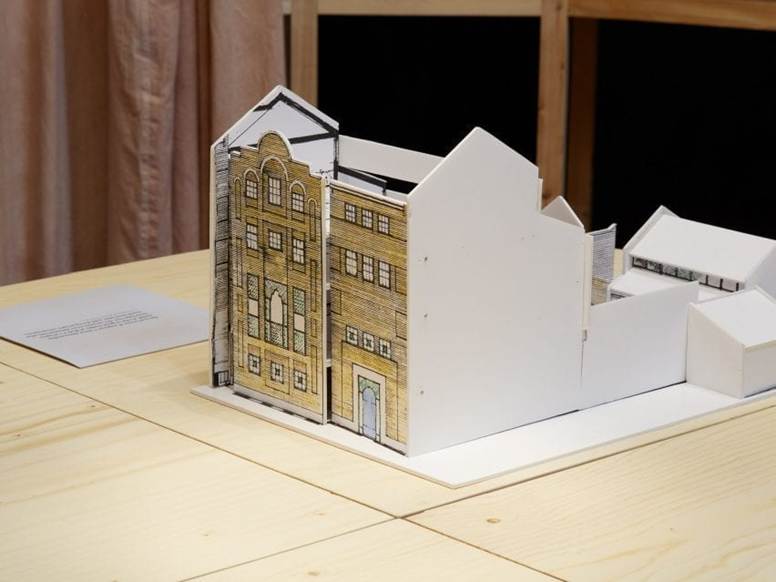
This approach reached its fullest expression at the Jagonari Educational Resource Centre (1985), a new build for a Bangladeshi women’s group in Whitechapel. Matrix worked closely with the community to shape every aspect of the building – its prominent kitchen, its colonnaded courtyard, its visual references to both Arts and Crafts and Indian architecture. The result was something genuinely co-created, and it became Matrix’s most celebrated building. It was the first building in the UK designed to provide full wheelchair access.
Throughout their span, Matrix focused on empowering women and saw women’s participation in the design process as crucial to making better buildings. When working on the Jumoke Training Nursery in Southwark (1988), they tried to hire women builders and found almost none existed in the formal trades. So, they helped establish training for women, published a guide called A Job Designing Buildings, and supported the launch of a pioneering “Women into Architecture and Building” course at the University of North London.
Matrix disbanded in the 1990s, but their legacy lives on. More broadly, their insistence that architecture is a social practice has become increasingly mainstream. Groups like Black Females in Architecture, the Part W Collective, and practices like muf architecture/art continue in their spirit, asking whose needs buildings truly serve and who gets to make those decisions.
The foundations of change
Today, we’re at a fascinating crossroads. For the first time, more than 50% of architecture students are women. Yet a “leaky pipeline” remains – only about 30% of registered architects are women, and even fewer are in senior leadership roles. The work of Matrix is a prime example of why this needs to change.
If you’d like to learn more about the amazing work women have provided the profession of Architecture, then please check out The The Bloomsbury Global Encyclopedia of Women in Architecture. It provides detailed biographies of more than 1,000 women across 135 countries. Including key figures like:
- Minnette De Silva (1918-1998) The first Asian woman elected as an associate of the RIBA.
- Jane Drew (1911-1996) A British powerhouse who specialised in “Tropical Modernism.”
- Tammy Eagle Bull (b. 1965) The first indigenous woman licensed as an architect in the history of the United States.


