A rather pleasant surprise to be contacted about some archival images.
Especially as I hadn’t yet had the opportunity to properly investigate the artist responsible. Thankfully, subsequent research has identified and shed light on both his working life and contemporaries. It’s been a pleasure to assist the exhibition curators by providing some details about Peter Sainsbury (1929-1976), who contributed to the University of Salford’s development drawings while working with Courtaulds Technical Services on the second campus-wide masterplan in 1964. Unfortunately, the University doesn’t hold any of the original sketches, only smaller photographic copies. Like many other institutions, the drawings were probably skipped over the years. Sainsbury’s architectural sketches once proposed the vision and ideals of past, but future developments. His work occupies the unique space between art, illustration and technical drawing. Below is a summary taken from the rigorously researched exhibition booklet and some interspersed archival images recently reconfirmed as him.
Peter Sainsbury was a leading British architectural illustrator, renowned for his distinctive and influential perspectives. Beginning modestly in 1956 with a single perspective painting of an office block for the North Thames Gas Board, he quickly rose to prominence. Over the next two decades, his work was regularly exhibited at the Royal Academy Summer Exhibitions. By the early 1960s, Sainsbury had become recognised as one of the foremost perspectivists of his generation, effectively succeeding Lawrence Wright as a dominant figure in architectural illustration. His works were highly admired and sometimes controversially debated, reflecting his artistic impact before his untimely death.
Born in 1929 in Wiltshire, he attended the Salisbury Cathedral Choir School and Bradfield College before winning a bursary in 1947 to study architecture at the prestigious Architectural Association in London. He developed a strong passion for architectural theory and design and graduated with an Honours Diploma in 1952. After completing his national service in the Royal Engineers, he worked as an assistant architect for Mayorcas & Guest, contributing to expanding national school projects. Sainsbury’s transition to full-time perspectivist came somewhat by chance in 1956 when he submitted a painting of a modern office block at Beckton gas works to the Royal Academy Summer Exhibition. His dynamic representation of the industrial site combined sharp architectural detail with an impressionistic treatment of the surrounding context, earning critical attention. This was the beginning of his prolific career as an architectural artist, frequently uncredited in official catalogues but widely recognised within the profession.
Throughout the late 1950s and 1960s, Sainsbury expanded his portfolio to include bridges, commercial buildings, higher education, such as the University of Manchester Umist campus, and the Business School, as well as other major infrastructure projects. He worked with notable architects and engineers, including Frederick Gibberd, Yorke Rosenberg Mardall, and R. Travers Morgan & Partners. His style became looser, more suggestive approach compared to his predecessors, characterised by distinctive human figures and natural elements that added life to his compositions. This is seen with the London Midland Region (1962), where he produced evocative perspectives for the redevelopment of Euston Station, images that showed the station’s sleek, futuristic design and became symbolic of the era’s railway modernisation efforts. Peter Sainsbury’s work is an integral part of mid-20th-century architectural illustration and well before the introduction and rise of Computer Aided Design. Despite his early death in 1976, he left behind a legacy of artistic innovation and contribution to architectural presentation, capturing the spirit of British post-war architecture.


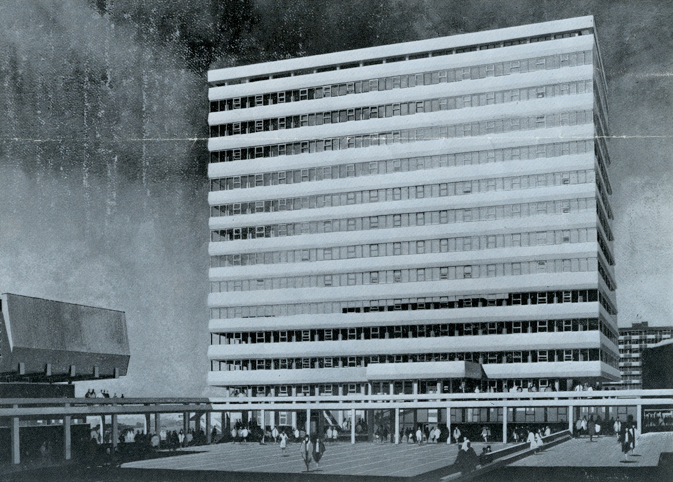


[…] one, an architectural perspective sketch of Salford precinct (and links nicely on from the last post). Ironically, there aren’t any copyright challenges with this as it’s via Salford Local […]
[…] one, an architectural perspective sketch of Salford precinct (and links nicely on from the last post). Ironically, there aren’t any copyright challenges with this as it’s via Salford Local […]