I was recently asked if parts of my thesis had previously appeared elsewhere in print or online.
The short answer is no.
This project website ran alongside my MPhil research which I’ve completed, with minor corrections submitted and the content published here is distinct from the main body of the thesis. While there may be minor thematic overlaps, everything on this site played a supportive role within a much larger research project rather than forming part of its core argument. Most of what appears here is organic, developing during the research process, particularly while scanning primary and secondary sources that informed the investigation’s methodology, narrative and direction. This site functions as a space to test ideas, record observations, and explore related material without shaping or reproducing thesis content directly. More recently, the website has taken something of a back seat. I haven’t visited the University’s Library and Special Collections for some time, and my attention has shifted to parts of life that were necessarily parked for over two years while I focused on writing, revising and questioning what I had produced. Anyone who has written a thesis will recognise that stage where sentences become paragraphs, paragraphs become essays, and meaning itself starts to feel questionable!
Returning to the original question, and thanks largely to WordPress’s built-in metrics, I was able to reflect on what this platform quietly achieved. Between June 2021 and August 2023, the site hosted 30 posts produced by myself and a small group of contributors. During that period, it attracted over 5,500 views from more than 2,400 visitors across 42 countries. Metrics can be interpreted in many ways, and comparisons are rarely helpful, but for a project that began without a strategy, fixed direction, or defined objective (beyond a logo inspired by the Maxwell Building) I’m pleased with that outcome.
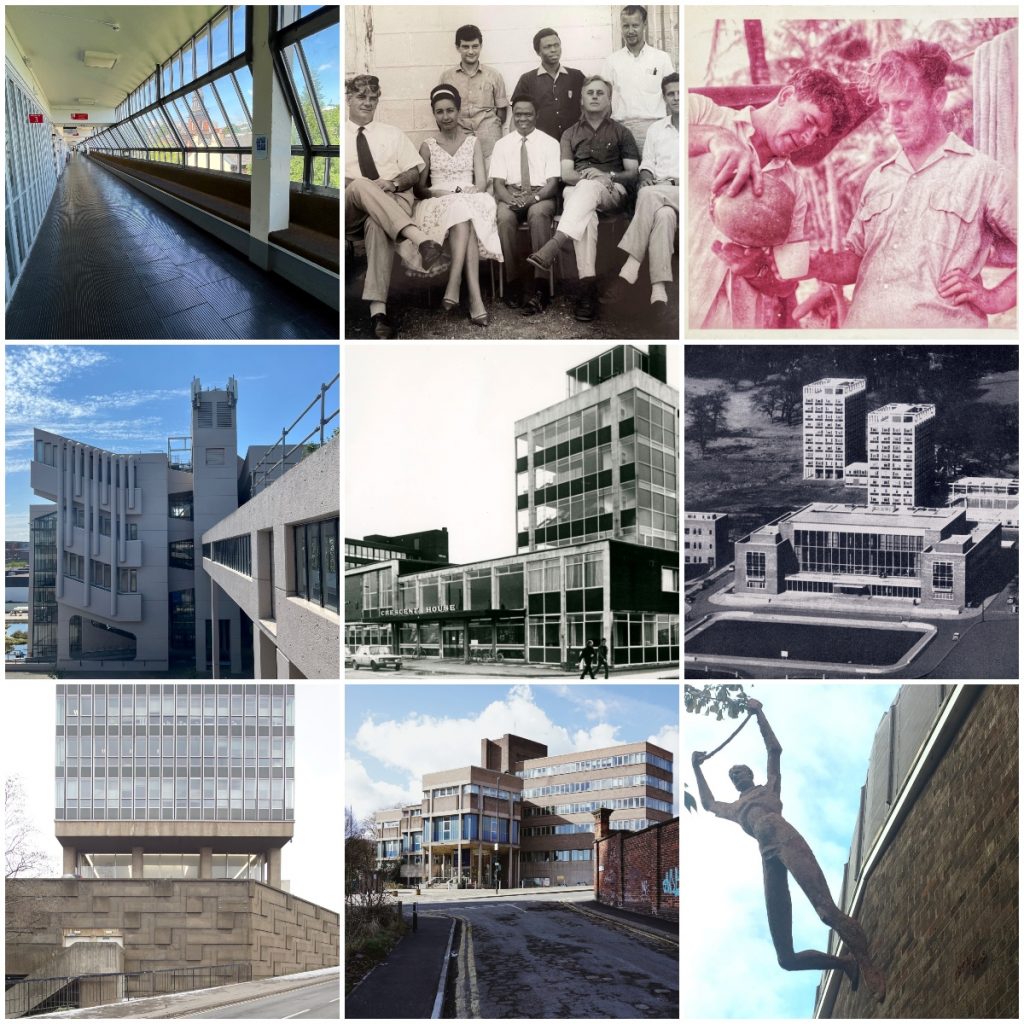
Alongside my own posts on archival research, the site provided an informal platform for contributors to write about architecture in higher education contexts at the Universities of Leeds, Sheffield, Swansea, York, and even internationally at the University of Ibadan in Nigeria. Public art and sculpture also featured, reflecting overlapping interests. Contributors included researchers, historians, and enthusiasts connected with modernist architecture and organisations. Rather than list names, it feels more appropriate to invite readers to explore the archive and encounter their work directly. Contributors also shared their posts through social media platforms, extending the discussion to national and international audiences. I remain genuinely grateful for their generosity and engagement. In many ways, this website became a collaborative process, unexpected, mutually supportive and very enjoyable.
All of this stemmed from an opportunity I took several years ago, one I hadn’t anticipated or actively pursued. We are often encouraged to plan carefully and define outcomes, but it’s worth remembering that some of the most valuable directions emerge without deliberate intention. When something feels positive and nudges you beyond your comfort zone, it’s often worth taking the step.