Written by Ubongabasi Kingsley Omon
The recent UK Council for Graduate Education (UKCGE) Conference 2025, held at the Advanced Research Centre (ARC), University of Glasgow from July 2nd to 4th, proved to be an incredibly enriching experience for me as an Equity, Diversity and Inclusion (EDI) Lead for the Doctoral School at the University of Salford. In attendance were dozens of heads of Doctoral Schools/Colleges/Administrative Units and Postgraduate Researchers (PGRs) from across the UK and Ireland.
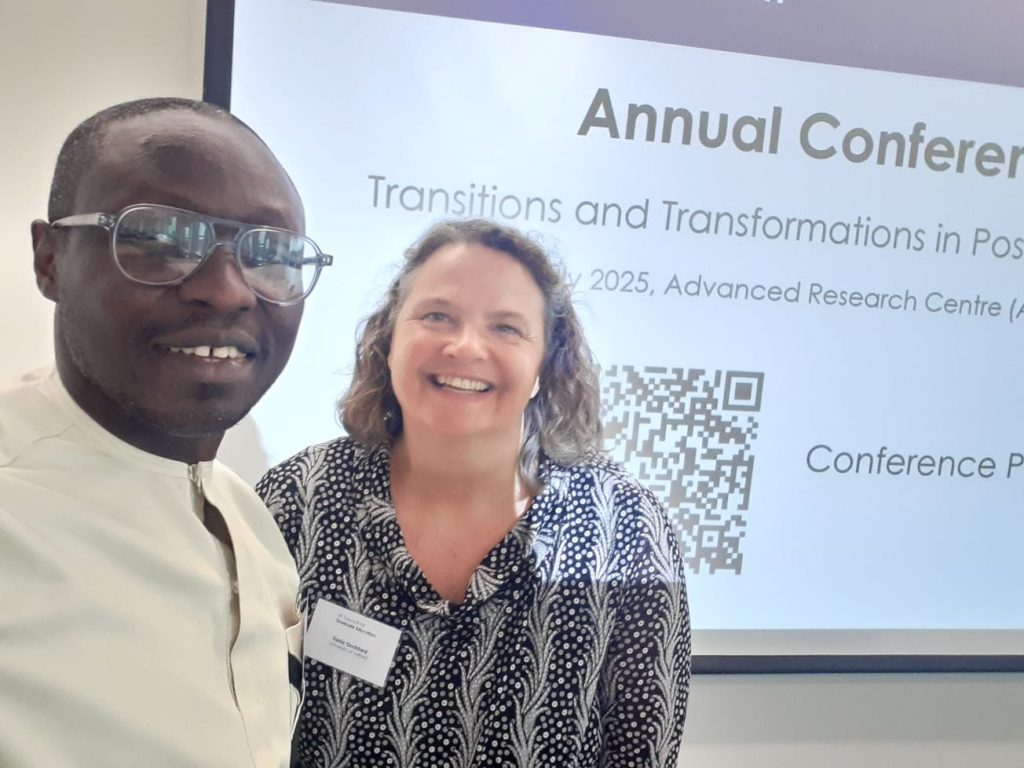
This event was a significant opportunity to deepen my understanding of the challenges faced by Postgraduate Researchers who are also carers and to forge crucial networks that will undoubtedly inform my capstone project and broader EDI initiatives.
The precursor event, ‘The Hidden Lives of PGRs’, was especially insightful. It offered a dedicated no-holds-barred space to explore various aspects of the lived experiences of PGRs – including specific nuanced intersectionality of those who are parents and carers, identify as neurodivergent, marginalised, minoritised, international student, and more. Discussions and presentations highlighted the multifaceted difficulties these students encounter, including time management issues, financial stress, coping with the higher education policy landscape, juggling family and academic demands, and the critical need for robust institutional support.
The full-day session further reinforced the importance of understanding the distinct experiences of both home and international PGR carers, acknowledging challenges such as cultural differences and limited access to local support networks.
This direct engagement with the experiences and challenges of PGRs solidified the relevance and justification for my research, which aims to improve current institutional systems and potentially develop targeted support strategies to enhance their academic success and well-being at the University of Salford.
Short Reflection on Key Themes: Transitions and Transformations in Postgraduate Education
The UKCGE Annual Conference 2025, themed ‘Transitions and Transformations in Postgraduate Education’, reflects a sector in flux, responding to global challenges and internal shifts with thoughtful innovation and a commitment to equity. Said succinctly, postgraduate education is undergoing a profound transformation, shaped by financial pressures, declining international enrolments, and the rise of generative AI.
The conference themes reveal a collective effort to not only adapt but to lead with purpose, and there was a strong emphasis on supporting students through transitions, whether academic, personal, or professional – highlighting the importance of inclusive admissions, skill development, and employability.
A significant thread running through the conference was the imperative for leadership and institutional change, with vibrant discussions focusing on fostering resilience and creativity in developing policy and strategy. The increasing integration of new technologies, particularly artificial intelligence, spurred critical reflection on maintaining academic integrity and reimagining the future of assessment.
Moreover, themes of equity, well-being, and sustainability emerged as guiding principles within the ‘People, Culture, and Environment’ discussions. Doctoral education itself was reimagined as a potent catalyst for social justice and broader societal transformation.
Ultimately, a deeper understanding of the diverse motivations driving individuals to pursue postgraduate study was highlighted as key to enabling institutions to provide more effective support for all learners. Collectively, these themes paint a picture of a sector not merely responding to the winds of change, but actively cultivating a postgraduate landscape that is more inclusive, responsive, and forward-thinking.
New Friends, New Networks, and New Perspectives: The Icing on the Cake
Prior to the main conference, I joined the conference delegation to attend the ‘Radical Glasgow Tours’. This 90-minute experience was profoundly impactful, offering a historical perspective on the many sacrifices and years-long struggles of activists and social campaigners who shaped the city. The beautiful narratives during the tour, which traversed several of Glasgow’s noteworthy streets and architecture, resonated deeply with the core social justice values of the University of Salford, underscoring the importance of advocating for and supporting marginalised groups within our own academic community.
Beyond the formal sessions, the conference facilitated the building of a robust network with other EDI leads, researchers, and doctoral school administrators from across the UK and Ireland. These connections are invaluable. Sharing insights on existing support systems and institutional policies, as well as discussing innovative approaches to address gaps, provided a rich comparative perspective.
Furthermore, learning about various coping mechanisms employed by diverse PGR demographics, such as neurodiverse individuals, disabled students, parents, carers, and international students, and assessing the effectiveness of different support strategies across institutions was particularly beneficial. This networking component will be instrumental in refining several aspects of my project, allowing for the identification of best practices and potential interventions that can be tailored to the University of Salford’s context.
Specifically, the conference afforded me the opportunity to spontaneously build a unique network of researchers also investigating similar issues I am working on and attempting to produce impactful solutions, albeit in silos. Consequently, I have received the commitment of several PGRs and doctoral school administrators from multiple universities, including the University of Glasgow, University of Sheffield, Brunel University, Robert Gordon University, University of Aberdeen, and Limerick University (in Ireland), among others, to build a unified platform where resources aimed at supporting home and international PGR student-carers and parents can be hosted.
Additionally, and as a pleasant surprise, the current Director of the UK Council for Graduate Education (UKCGE), Dr Owen Gower, has expressed his delight at the initiative and mooted the possibility of the UKCGE potentially supporting the project. This singular outcome means my initial proposal to create a one-stop-shop for Salford PGRs to find support resources may just go national, covering all Higher Education Institutions (HEIs) in the UK. Fingers crossed!
The conference dinner, held at the Fonn Mór – part of Òran Mór Restaurant, provided a wonderful setting for enriching but lighthearted discussions, further solidifying the connections made throughout the formal sessions.
Overall, the UKCGE conference was not merely an attendance but a strategic engagement that has significantly advanced my understanding and approach to supporting PGR carers. The knowledge acquired, coupled with the valuable networks established, will be pivotal in shaping effective, evidence-based policies and support mechanisms at the University of Salford, ultimately contributing to a more inclusive and equitable academic environment for all PGRs.
I am indeed grateful to Professor Katherine Yates and the entire Doctoral School team for providing this priceless opportunity, and I hope to keep pushing the boundaries, with the confidence that my project will culminate in a more equal, diverse, and inclusive PGR ecosystem at the University of Salford and beyond.