The Manchester Guardian, 26 March 1896, p. 5.
A cleaned transcription of the newspaper report. The original wording and sequence have been retained, with corrections to obvious transcription errors and adjustments to punctuation, paragraph breaks and time formatting.
Loyal reception of the Duke and Duchess of York
When the Duke and Duchess of York bade “good-bye” to the municipal representatives of Salford yesterday, the Duke, standing at the door of the Royal saloon, told the Mayor that he would long retain pleasant recollections of his reception by the burgesses. The remark was evidently no mere complimentary passage of words. Both the Duke and Duchess were everywhere visibly affected by the spontaneous enthusiasm of the great crowds of Lancashire people that filled the streets along which the procession passed.
Outside Seedley station, where the journey through the borough began, men and women, long before the time for which the arrival was fixed, had taken up every square yard of standing room. There were no barriers, and only a thin line of police and volunteers. But everyone kept perfect order. When the Duke and Duchess had taken their seats in the carriage sent over from Knowsley by Lord Derby, the Duke on the right and the Duchess on the left, with Major General Sir Francis de Winton in attendance, the silence was broken. By common instinct the whole assembly cheered. The Duke stood for a moment acknowledging the heartiness of his welcome before the carriage began to move away.
There was then a general movement to “close up” around the Royal carriage, and perhaps the greater share of the curiosity which prompted this was directed towards the Duchess, whom the crowd, with a touch of emotion, everywhere spoke of as “Princess May”. The Duchess looked remarkably well. She wore black with gold figuring upon the bodice, and a bonnet trimmed with lilac-coloured ribbon. The Duke, of course, was in ordinary morning costume.
The procession itself was sufficiently imposing. It was headed by a detachment of mounted police. Then followed a carriage with several of the ex-Mayors of the borough, another containing the Rev. Fergus Hill (the Mayor’s chaplain) and Mr. Wilson, principal of the new Technical Institute, to open which was the object of the Duke’s visit. Behind these rode the three Parliamentary representatives of Salford, Sir H. Howorth, Mr. Lees Knowles, and Mr. Platt Higgins. The aldermen, who followed, included Mr. B. Robinson, the chairman of the Technical Instruction Committee of the Salford Borough Council.
The High Sheriff of the county (Mr. F. Hardcastle), in his official dress, rode along with the Earl of Sefton (Lord Lieutenant) in his state carriage. With the Mayor and Mayoress of Salford, who followed, there were the Recorder (Mr. J. M. Yates, Q.C.) and the Town Clerk (Mr. S. Brown). Immediately behind the Mayor was the Royal carriage, escorted by a detachment of the Royal Welsh Fusiliers. The Earl and Countess of Derby and the Earl and Countess Cadogan were in the carriages which followed that occupied by the Duke and Duchess of York.
Langworthy Road, along which the procession first passed on its way to the Pendleton Town Hall, is about a mile in length. It was decorated with “Venetian masts” draped in crimson, garlanded with imitation flowers, and hung with flags. The design was certainly not new, but under the grey Lancashire sky, with here and there a background formed by the walls of mills and factories, with tall chimneys lifting themselves into the mist, bright colour of almost any kind was agreeable.
In Langworthy Road more than 10,000 of the school children in the elementary schools of the borough were massed. They held bunches of flowers, and cheered the occupants of every one of the carriages vigorously. But they had always a little additional lung power for the Royal carriage, their pitch was then higher, and they were undoubtedly gratified when “Princess May” responded with bows and smiles to the pleasant sound of their clear trebles.
In Eccles Old Road, into which the procession turned, some of the decorations were tasteful. The front of the High School was prettily tricked out with daffodils, which surrounded a scroll of “Welcome”. Early spring flowers were also used by a number of the owners of shops nearer the Town Hall. There was almost a remarkable unanimity in the choice of a motto for the different devices. “Welcome to the Duke and Duchess of York” was displayed everywhere.
That design was written on the principal triumphal arch which, in a kind of Norman style, was built across Crescent Road almost opposite the new Technical Institute. On the pillars of its main arch there stood men in armour, with a trumpeter upon the topmost battlements, who, with a lively air, announced the approach of the procession. The signal attracted some thousands of people to that part of the wide thoroughfare which fronts Peel Park. They cheered the Royal visitors long after the carriages had passed through the park gates.
In the new building, which is situated within the park, the chief ceremony of the day was of course performed. Meanwhile the crowds increased in strength until, when the party left the school on their way to the Exchange Station, no more than a passage-way for the procession remained. At Oldfield Road and all the other streets which converge on Chapel Street, along which the procession passed, cabs and carriages, omnibuses and tramcars, were drawn up, and were invaded until the whole thoroughfare became like a street built up on either side with human faces.
Almost more remarkable than the scene was the sound of the constant cheering. It came at once from children wedged at the feet of men and women, from the people who stood upright, from others lifted higher, and from small crowds at the windows and on the roofs. Where, after passing the Salford Town Hall, Chapel Street begins to narrow, barricades had necessarily been set up, and flags and banners were more plentifully displayed. The striking picture of humanity wedged in amongst this mass of colour appeared to particularly affect both the Duke and Duchess.
When their carriage was drawn up at the door of the Institute for this last portion of their progress through the town rain fell, and, the carriage being an open one, the Duchess raised her umbrella. “Oh, put it down, please,” cried one of a small party standing near the door, “and let the people see you. You’re bonny enough for anything.” The Duchess, smiling, took this loyal if outspoken advice, and, notwithstanding a sharp shower, acted on it until the procession had reached the Exchange Station.
The arrival at Seedley
The Duke and Duchess and their party were timed to arrive at Seedley station at 11.45. Leaving Knowsley a few minutes before eleven o’clock, they drove to Huyton, on the London and North-Western Railway, and there entered the Royal saloon of the special train which was waiting for them. They were accompanied by their host and hostess, the Earl and Countess of Derby, Lord and Lady Cadogan, the Earl of Sefton, Major General Sir Francis de Winton, Lady Mary Lygon, and Sir Charles Cust. Mr. Alfred Fletcher, one of the directors of the London and North-Western Railway Company, and Mr. James Shaw, district superintendent, from Lime Street station, Liverpool, also travelled by the train for the purpose of seeing to the successful completion of the arrangements for the journey.
The train consisted of four vehicles, viz. a third-class brake, the Royal saloon already mentioned, which is reserved for the exclusive use of the Prince and Princess of Wales and the Duke and Duchess of York, a first-class saloon, and a composite brake. Huyton station was left at 11.15 amidst the cheers of the people who had assembled there, and there was a continuance of these loyal manifestations at various points along the route.
Meanwhile Mr. G. E. Mawby, the district superintendent, and other officials of the Railway Company had been perfecting the arrangements for the reception of the Royal party at Seedley. A glance round the station and up the steps leading into Langworthy Road showed that everything possible had been done, by means of flags and other draperies, to make the surroundings as gay as possible.
Outside the station the carriages for the Royal and distinguished visitors were in waiting, a guard of honour of the 3rd V.B. Lancashire Fusiliers was drawn up, the escort of mounted police was in evidence, and crowds of people had taken up positions on either side of Langworthy Road. A few minutes before the time appointed for the arrival of the train the Mayor (Mr. Alderman Richard Mottram) and the Mayoress drove up. His Worship was in Court dress, as were also the Recorder (Mr. J. M. Yates, Q.C.) and the Town Clerk (Mr. S. Brown), who accompanied him.
There were likewise present Mr. F. Hardcastle, High Sheriff of the county; Mr. W. W. B. Hulton, Constable of Lancaster Castle; and Colonel Studholme Brownrigg, commanding the troops in this district, who had charge of the military arrangements connected with the visit. The Mayoress carried a beautiful bouquet, composed chiefly of lilies of the valley, orchids, and ferns, for presentation to the Duchess.
A few minutes after the Mayor and Mayoress and the others had arrived, the Royal train steamed slowly into the station, and hats were raised as the Duke and Duchess and the members of their party alighted. Both the Royal visitors, it was observed, looked remarkably well. Lord Derby introduced the Mayor and Mayoress, and the Mayor afterwards introduced the Recorder and the Town Clerk. Colonel Brownrigg had also the honour of an introduction. In almost as short a time as it takes to chronicle the fact, the party, led by the Recorder and Town Clerk, were on their way along the platform and up the staircase. Their arrival in Langworthy Road was greeted by a loud cheer from the crowds of people assembled.
Presentation of the Corporation address
The Royal party reached the Town Hall at Pendleton at 12.15. Here there was a halt of ten minutes for the presentation of an address from the Corporation. The brief ceremony was observed by a very large number of persons, who had been waiting for more than an hour. The windows of the Town Hall were filled with ladies, and on the steps were the members of the Corporation, wearing the medals cast in honour of the visit of the Queen to open the Ship Canal. A guard of honour of the Manchester Artillery Volunteers was present under Captain Coghill.
The Mayoral party, who were in the carriage preceding their Royal Highnesses, got out and took their places on a narrow platform which ran from the steps of the Town Hall to the carriage way. The platform was covered with red cloth and decorated with flowers and shrubs. When the royal carriage drew up and the Duke and Duchess alighted there was a burst of cheering, and the band of the Artillery Volunteers played the National Anthem. The bells of the adjoining church of St. Thomas joined in the welcome.
The daughter of the Mayor, a child of three years, dressed in white, stepped forward and offered to the Duchess a basket of red and white roses. The Duchess smiled sweetly on the pretty little girl and accepted her fragrant gift.
The Recorder read the address of the Corporation, which is in the following terms:
To their Royal Highnesses the Duke and Duchess of York.
May it please your Royal Highnesses, we, the Mayor, aldermen, and burgesses of the county borough of Salford, beg to offer to your Royal Highnesses a hearty and loyal welcome in your visit to this ancient and royal borough to perform the opening ceremony of the new Technical Institute of Salford.
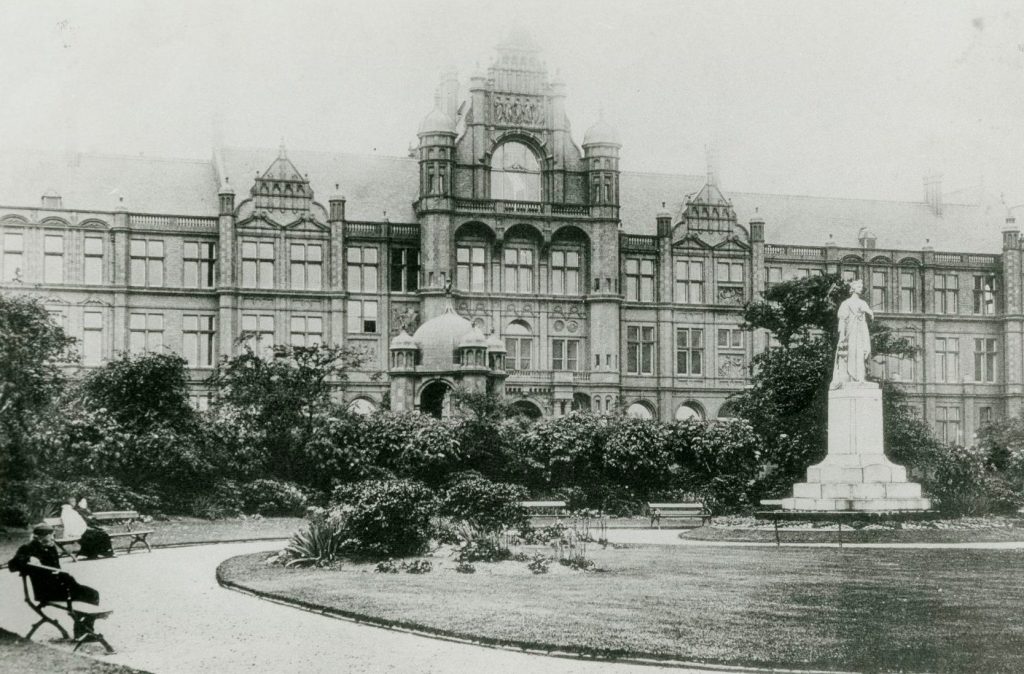
We congratulate your Royal Highnesses that your first visit to this borough will be memorable as being connected with the inauguration of one of the most important modern educational establishments of the century, the demand for which, in the interests of the development of trade and the expansion of the commerce of the nation, has been urgently made from year to year, and has been responded to by the Council of this borough by the erection of the splendid and commodious structure in Peel Park now about to be opened.
The technical and scientific instruction which will be imparted in the institution in connection with the staple trades and various industrial handicrafts of which this district is so important a centre will enable those who avail themselves of its advantages, in common with a large number of others who are receiving a like training in similar institutions throughout the country, to uphold that supremacy in the markets of the world for executive skill in products of the trades, the manufactures, and the commerce of England which she has hitherto so long enjoyed.
We trust that your Royal Highnesses may be blessed with health and strength for many years not only to manifest your interest in the industrial and educational institutions of the country, but also be enabled to undertake the function, in the distant future, of that exalted position which your Royal Highnesses are destined to fulfil.
Given under our common seal this 23rd day of March, 1896.
Richard Mottram, Mayor.
Saml. Brown, Town Clerk.
The Prince, in reply, said:
It gave both to the Duchess of York and myself sincere pleasure to accept your kind invitation to visit the ancient and loyal borough of Salford, and we thank you for your hearty and loyal welcome. I am pleased to think that our visit to-day is connected with the important subject of technical education. There is now so much competition in the world that unless our artisan and working classes can obtain higher instruction in the industries and handicrafts to which they belong the trade and commerce of the nation must eventually suffer.
The erection of this technical institute will meet the demand for that higher education in the arts and sciences you so greatly need, and being situated in close proximity to the public library and museum, it will afford another example of the public spirit and enterprise which animate your citizens. Again I thank you for your kind welcome, and for the concluding words of your address.
When the procession again got in motion it was joined by the members of the Corporation, who had been in waiting at the Pendleton Town Hall.
The ceremony at the Technical Institute
What is known as the large hall of the Technical Institute, in reality it is a handsome and commodious lecture theatre, was well filled by noon. The invited company included, among many others, Dr. A. W. Ward, Principal of Owens College, Mr. C. E. Schwann, M.P., Mr. T. Snape (chairman of the Technical Instruction Committee of the Lancashire County Council), Canon Scott (chairman of the Salford School Board), the Dean of Manchester (chairman of the Manchester School Board), the Lord Mayor of Manchester (Mr. Alderman Lloyd) and the Lady Mayoress (Mrs. Meek), Alderman Sir Anthony Marshall and Lady Marshall, Mr. Alderman Mark, Mr. W. H. Holland, the Mayor (Mr. Alderman Hindley) and Mayoress of Eccles, Mr. S. R. Platt, Mr. H. J. Galloway, Mr. Edward N. Galloway, Mr. J. A. Bennion (director of technical instruction for the County Council), the Chevalier Froehlich, Mr. J. G. Groves, Dr. Meek, the Rev. H. F. Gore-Booth, Sir Henry and Lady Howorth, Mr. S. L. Helm, Major Le Gendre Starkie, and the Bishop of Salford (Dr. Bilsborrow).
The tedium of waiting was relieved by an excellent performance by a portion of Sir Charles Hallé’s orchestra. The programme included the overture “Raymond” (Thomas), three dances from “Henry VIII” (E. German), a morris dance, a shepherds’ dance, and a torch dance, a selection from “The Gondoliers” (Sullivan), and the waltz “Moonlight” (Henry).
The procession having reached the Technical Institute, the Mayor presented to their Royal Highnesses the chairman of the Technical Instruction Committee, Mr. Alderman Benjamin Robinson. Mr. Robinson placed in the hands of the Duke the presentation key in gold and invited him to open the door of the Institute. Mr. Robinson, it may be mentioned, had laid the foundation-stone of the Institute. His Royal Highness at once complied with the request.
Entering the building, the Duke and Duchess proceeded, with the Mayor and all the other members of the party, to the platform of the large hall, the company rising on their entrance. The procession to the platform was formed in the following order: officer commanding the troops, Principal Wilson and the Mayor’s chaplain, Mr. F. Platt-Higgins, M.P., and Mrs. Platt-Higgins, Mr. Lees Knowles, M.P., Sir William and Lady Bailey, Sir Henry and Lady Howorth, the Recorder and Town Clerk, Mr. Alderman Shaw and Mrs. Shaw, Mr. Henry Lord (architect) and Mrs. Lord, Mr. Alderman B. Robinson and Mrs. Robinson, the Constable of Lancaster Castle (Mr. W. W. B. Hulton), the High Sheriff of Lancashire and the Hon. W. Walsh, Sir Charles Cust and Lady Mary Lygon, Lord Sefton and Major General Sir Francis de Winton, Lord Cadogan and Lady Cadogan, Lord Derby and Lady Derby, the Mayor and Mayoress, and their Royal Highnesses the Duke and Duchess of York.
As the Royal party filed down the gangway the orchestra played the National Anthem. Madame Conway next sang the first verse of the anthem and a quartet party the second. The Mayor’s chaplain (the Rev. Fergus Hill) offered prayer.
The Mayor expressed the pleasure and happiness that the people of Salford felt in the presence of their Royal Highnesses. (Applause.) Directly it became known that their Royal Highnesses had accepted the invitation to visit the borough the greatest enthusiasm prevailed, and they all felt under a deep debt of gratitude to Lord Derby for his kind offices in this matter. (Applause.) Salford people were loyal to a degree, and were always glad to show their respect to members of the Royal Family. (Applause.)
Her Majesty the Queen had visited the borough upon three occasions, the first in 1851, the second in 1857, and again in 1894 to open the Ship Canal. Had the Duke and Duchess of York’s visit been a little later in the season there was no doubt they would have been landed upon their shores at the Salford docks. (Laughter.) The Prince and Princess of Wales had also visited Salford when opening the Jubilee Exhibition. On each occasion the people had given Royalty a hearty reception. To-day was no exception to that rule.
The scenes in the streets must have been very gratifying, and more so when they knew that the whole of the decoration both of streets and public buildings was a spontaneous effort on the part of the people, and that there had been no call upon the rates. Salford had not many features of architectural beauty, but this Technical Institute, which did so much credit to its architect (Mr. Lord), would certainly be an improvement in this respect.
The room in which they were assembled would enable the Corporation to increase the recreation of large masses of the population, and all the more so when they had the splendid organ to be erected in this room, the gift of Mr. Lees Knowles, M.P. The visit of that day gave the inhabitants of the borough another opportunity of showing their loyalty and devotion to Her Majesty the Queen, whom they were proud to acknowledge as lady of the manor of Salford. (Applause.) He had now the pleasure of calling upon Principal Wilson to read an address from the Governing Body of the Institute.
The address was read by Principal Wilson and presented by Mr. Alderman B. Robinson. It was in the following terms:
To their Royal Highnesses the Duke and Duchess of York.
We, the Governing Body of the Salford Technical Institute, being a committee comprising members of the County Borough Council, and also a number of co-optative members representing the principal industries of the town, beg to approach your Royal Highnesses upon the occasion of your visit to Salford to open the Institute, and to tender to your Royal Highnesses our loyal and dutiful welcome.
The important duty with which we are charged by the Council of the borough is receiving our earnest care and attention, with the exercise of such special knowledge as we possess, to ensure that the courses of study and technical training to be provided in the Institute shall meet the requirements of the students who will avail themselves of its advantages, and thus acquire for themselves such scientific and artistic knowledge as may be applicable to the important trades and industries of the town and neighbourhood.
Whilst providing ample accommodation for instruction in other branches of technical knowledge, we have made an unusually large provision for the study and practice of mechanical and electrical engineering, as this is a most important and progressive industry in our town, and employs a large proportion of our industrial population.
We gratefully acknowledge the compliment paid to the town of Salford, and especially to our Technical Institution, by the visit of your Royal Highnesses, and we hope that by the blessing of divine providence you may long be spared in health and happiness to discharge the duties and enjoy the privileges of the exalted station to which you have been called.
Signed, on behalf of the members of the Technical Instruction Committee, this 25th day of March, 1896.
Benjamin Robinson, Chairman.
Joshua Shaw, Deputy Chairman.
In reply, the Duke said:
I thank you for the kind welcome you offer to the Duchess of York and myself on this occasion. And I can assure you that the interesting ceremony of opening your Institute affords us great pleasure and satisfaction. The immense and important industries which are carried on in this borough, which give employment to so many thousands of its inhabitants, demand support and encouragement, and you have discharged a public duty in providing suitable accommodation and appliances for the students who desire to educate themselves in the higher branches of the arts and sciences.
We know that the establishment of institutions similar to this one in other large cities and centres of industry have proved most useful, and I venture to hope that Salford will reap the fruits of its labour in erecting this building by the benefits it will confer upon the community, and by the advancement of your commerce. In conclusion we thank you for the kind allusions you express towards ourselves. (Loud applause.)
I have now great pleasure in declaring this technical institute to be open, and I wish it a long and prosperous career of usefulness. (Prolonged applause.)
The hymn “All people that on earth do dwell” having been sung by the audience, the Mayor asked Lord Derby to be good enough to say a few words.
Lord Derby, who was received with applause, said it was only with their Royal Highnesses’ sanction that he presumed to add a word. The Mayor had truly spoken of the joy felt in Salford, in the district, and in the county generally at their Royal Highnesses’ most gracious and kind consent to accede to the request made to them, on the occasion of their visit to Lancashire, that they would open the Technical Institute. (Applause.) It would help to revive, if that were necessary, the memory of the visits of the Queen to the borough, of which she is the Lady of the Manor. (Applause.)
Through the Duke and Duchess they ventured to offer their humble and continued tribute of respect to the Queen, and to thank Her Majesty for giving permission to the Duke and Duchess for performing the duty of that day. He was sure that on behalf of the county, although he spoke in the presence of the Lord Lieutenant, who would have more fitly represented the county, he thanked the Duke and Duchess for the honour which they had conferred by their present visit. Salford especially was most deeply grateful. (Applause.)
The quartet party sang “The Sailor’s Wooing” (Eaton Faning), accompanied by the orchestra. The Mayor then presented the following ladies and gentlemen: the Borough Coroner (Mr. A. Holmes), Sir Henry and Lady Howorth, Mr. Lees Knowles, M.P., Mr. F. Platt-Higgins, M.P., and Mrs. Platt-Higgins, Mrs. B. Robinson (wife of the chairman), Mr. Henry Lord (architect) and Mrs. Lord, Sir W. H. Bailey and Lady Bailey, Lord Mayor of Manchester and Lady Mayoress, Mr. Alderman Shaw (deputy chairman of Technical Instruction Committee) and Mrs. Shaw, Mr. Alderman Walmsley and Mrs. Walmsley, Mr. Alderman W. Robinson and Mrs. Robinson, Mr. A. L. Dickins, the Mayor’s Chaplain, and Principal Wilson. This done, the Royal party returned from the hall, to the strains of the Grand March from “Tannhäuser”.
The luncheon
At two o’clock luncheon was served to over 250 guests in the room which will in the future be known as the Chemical Theatre. The room had been decorated with flowers, palm trees, and elegant draperies, and presented altogether a very pleasing appearance. The Mayor presided, having on his right the Duke of York, and the Duchess on his left. Grace was sung before and after the repast by the quartet party composed of Madame Conway, Madame Bertenshaw, Mr. H. Daniels, and Mr. A. S. Kinnell; Mr. C. F. Daber presiding at the piano. During the luncheon the following pieces were sung: “Come, live with me” (Bennett); “When hands meet” (Pinsuti); “You stole my love” (Macfarren); and “Ye Mariners of England”.
At the close of the luncheon the Mayor proposed the toast: “Her Majesty the Queen, the Duke of Lancaster and Lady of the Manor of Salford.” “We all entertain,” he said, “such feelings of respect for our Sovereign and such profound admiration for her many virtues that I give you the toast without further words.” (Applause.)
The next toast was “Their Royal Highnesses the Prince and Princess of Wales, the Duke and Duchess of York, and the other members of the Royal Family”. The Mayor, in submitting the toast, said:
My lords, ladies, and gentlemen, the next toast I have to propose is that of their Royal Highnesses the Prince and Princess of Wales, the Duke and Duchess of York, and the other members of the Royal Family. The Prince of Wales has identified himself with the public life of England, and has shown such an interest in every movement for ameliorating and improving the condition of the masses in our large towns as to excite our cordial admiration. (Hear, hear.) With respect to the Princess of Wales it is somewhat difficult to speak. She is beloved by all. (Applause.) By the sweetness of her disposition and her true nobility of character she has set a bright example to the women of England. (Applause.)
With regard to our royal visitors to-day, their Royal Highnesses the Duke and Duchess of York, it has afforded the Mayoress and myself extreme pleasure to receive them as our guests in this royal and ancient borough of Salford; and I am sure that our joy and our pleasure to-day are shared by every member of the Salford Corporation and by every inhabitant of this borough. (Applause.) His Royal Highness the Duke of York is taking a very active part in public affairs in this country; he is taking great interest in philanthropic and educational affairs. Yesterday he opened the Lancaster Infirmary, and to-day he comes amongst us to open our Technical Institute. Both these ceremonies are fraught with utility, and we are glad to see that His Royal Highness is ably assisted by Her Royal Highness the Duchess of York. (Applause.)
Those who read the newspapers must often have been struck with the grace and unaffected dignity with which their Royal Highnesses carry out the many duties that appertain to their exalted station. (Hear, hear.) We hope the lives of your Royal Highnesses and those of your children may be spared for many, many years; we hope those years will prove a blessing to yourselves and be a satisfaction and pleasure to you, and that you may be the means of conferring great blessings upon the people of this country. (Applause.) My lords, ladies, and gentlemen, I ask you to drink with all enthusiasm the health of their Royal Highnesses the Prince and Princess of Wales, the Duke and Duchess of York, and the other members of the Royal Family. (Applause.)
The Duke of York, who was received with hearty and prolonged cheering, said:
Mr. Mayor, my lords, ladies, and gentlemen, I thank you, Mr. Mayor, most sincerely for the very kind words you have been good enough to use in proposing this toast, and I thank you all most heartily for the kind way in which you have received it. The Duchess and myself greatly appreciate the very kind welcome and reception which has been given us to-day by the people of Salford, and I can assure you that we shall not easily forget it.
I am happy to think that Salford is not only connected with my family through the Queen as the Lady of the Manor, but that she has twice paid you a visit, in 1851 and 1857; and my father and mother also visited your borough, I think, in 1869. I am sure these visits gave them as much pleasure as our visit gives us to-day. (Applause.) We came here to-day, as you know, to open the Technical Institute, and we feel that we have taken a part in a ceremony which cannot fail to be of the greatest benefit to your industrial and working classes. (Hear, hear.)
This building has been erected at a cost of £70,000, and as it was designed after careful consideration of the principal kindred institutions in existence, it is probably one of the most complete of its kind in the United Kingdom. (Applause.) I learn also that the School provides accommodation for 2,300 students, and that both day and evening classes will be held. I am pleased to know that it will also work in complete harmony with the other educational establishments of the borough. (Hear, hear.)
The population of Salford is now three times as large as it was fifty years ago, which fact proves how its industries and its commerce have increased during that period. Therefore I have great pleasure in proposing the toast of “Continued prosperity and success to the royal borough of Salford” (applause); and with this toast I beg to couple the name of the Mayor, Mr. Alderman Mottram; and I take this opportunity of thanking him on behalf of you all for his most kind hospitality on this occasion. (Applause.)
The speech, which had the appearance of being extempore, was delivered with force and fluency. His Royal Highness showed that he has a good voice and has been carefully trained in the art of public speaking.
The toast having been duly honoured, the Mayor briefly responded. This, he said, was a great day for the borough of Salford, but it was a greater day for the people of Salford. It would also be a “red-letter day” to himself and the Mayoress, for it would always be a source of gratification to them to think of what they had seen that day in the streets and the welcome given to the Royal visitors. He assured their Royal Highnesses that their visit had been a source of unmixed pleasure, and that it would redound to the success of the institution with which their visit was more immediately associated.
“We were very delighted,” said the Mayor, “when we heard there was a possibility of your coming amongst us, and the pleasure of seeing you with us has been extremely great. We are glad to have seen you to-day, and we know that your visit will not be without a very beneficial effect. It will give an impetus to this institution which otherwise it would not have had. (Hear, hear.) It has called attention to the work that will be carried on within its walls, and I am sure your visit will prove of great service to the Institute. I thank your Royal Highness for honouring us with your presence on this occasion, and for the way in which you have proposed success to this borough.” (Applause.)
The Royal guests then retired to the Mayoral apartments to take tea with the Mayoress, the Albertini Band being meanwhile stationed in the corridor and playing selections of music.
At 3.40 a procession was again formed, and the Duke and Duchess passed through densely crowded streets to the Exchange Railway Station. A brief halt was made at the Salford Royal Hospital while their Royal Highnesses were presented with a basket of flowers and a bound volume of the work entitled “Three Weeks in the Salford Hospital”. Everywhere along the route the Royal visitors were very cordially greeted.
Their Royal Highnesses were timed to leave the Exchange Station on their return to Knowsley at 4.10. The Salford approach to the station was decorated with Venetian masts, flags, and strings of fluttering streamers, and the entrance to the platform was draped with flags and banners. A broad crimson carpet covered the footway from the point at which the Royal visitors alighted to the door of their saloon, which was drawn up immediately opposite.
Guards of honour were furnished by a strong detachment of the Salford Volunteers, under Major Moss, and the Manchester Cadet Battalion, under Major Ledward. The Cadets lined the station approach, the Salford men, with their band, occupying the front of the station. A large number of privileged persons were permitted to line both sides of the station approach, while at the entrance to the station a considerable crowd had assembled. The possessors of special passes enjoyed the privilege of witnessing the leave-taking of the Royal party on the departure platform. Music was furnished by the band of the Salford Volunteers.
The hope that there would be no rain to mar the proceedings of the day were, unhappily, not realised, for shortly before four o’clock a smart shower fell. The downpour had not ceased when the appearance at the foot of the station approach of a detachment of mounted police, headed by the Chief Constable and his deputy, indicated the approach of the Royal procession. Their Royal Highnesses rode in the tenth carriage, and as it drew up the Volunteers presented arms and the band played the “National Anthem”.
There were present to receive the Duke and Duchess on behalf of the London and North-Western Railway Company Mr. Alfred Fletcher (Liverpool) and Mr. W. Dorrington (Manchester), directors; Mr. G. E. Mawby, district superintendent; and Mr. G. Hitchenor, station master; Mr. J. H. Stafford, general manager of the Lancashire and Yorkshire Railway, was also on the platform. There was much cheering as their Royal Highnesses passed into the station, whither they had been preceded by the Mayor and Mayoress of Salford and others.
Before entering the train the Duke and Duchess bade farewell to the Mayor and Mayoress, cordially shaking them by the hand. His Royal Highness expressed to the Mayor the great pleasure the visit had given himself and the Princess, and said the arrangements had been all that could be desired. The Princess also added a word of thanks to the Mayoress, and the Town Clerk and the Recorder were specially included in the leave-taking. Lord Derby, to whom a special recognition was given, Lady Derby, and the remainder of his Lordship’s party entered the train, and at a quarter-past four it steamed out of the station on its way to Huyton, amid continued cheering.
The illuminations
At dusk the principal streets through which the Royal party had passed were illuminated. The principal show was at Peel Park. Coloured lights were hung round the park walks, and the front of the Museum was also similarly illuminated. The centre of the Technical school was adorned with a coloured picture of the Duke of York, surrounded with gas jets. The crest and motto of the Prince of Wales were also shown with coloured effects.
The front of the Town Hall and of the new School Board offices were hung with small lamps and with festoons of Chinese lanterns, and a considerable number of the places of business had illuminated devices. The Salford Royal Hospital, at which the procession had made a halt in the afternoon, when the Duke of York was presented with a book giving some account of the work done at the hospital, was hung round with coloured lights, and the Pendleton Town Hall and the Tramway offices at Pendleton were lit up very effectively.
An arch made by the Salford Fire Brigade of fire escapes, decorated with flowers, was illuminated with lanterns, and the front of the Zetland Lodge of the Order of Freemasons, in the Crescent, and also of the Home of the National Society for the Prevention of Cruelty to Children, at Windsor Bridge, were lighted with coloured lamps.
The Crescent, near Peel Park, was at times almost impassable, owing to the immense number of people who, coming from all directions, concentrated there, but the police arrangements were admirable, and with the exercise of good humour and patience the crowd was “kept moving”. The police arrangements during the day were, at the Pendleton end of the route, under the charge of Superintendent Meade, of the A division of the City Police, who had under him a strong detachment of the force. In Salford the Chief Constable (Commander Scott) was responsible for the conduct of the proceedings, which were well ordered throughout.
Transcribed from the original source material with AI assistance, with minor corrections for clarity where the quality of the original print affected legibility.