Shortly after The Plateglass Universities (1968) came Building the New Universities (1972).
Published four years after Michael Beloff’s The Plateglass Universities, architectural historian Tony Birks’ study takes a more focused approach, examining the architectural and environmental impact of the seven newly created universities. Rather than documenting their academic structures, he explores what makes each institution’s architecture distinctive, including financing, library design and student housing: areas that shape the student and community experience.
Birks writes in a systematic, formal tone, perhaps a little dry, but his architectural expertise shines through. He avoids Beloff’s terminology, referring to the institutions simply as “the seven”, echoing the terminology of the University Grants Committee. Both writers explore their creation within the wider expansion of higher education, accelerated by the Robbins Report on Higher Education (1963) which also supported the elevation of the Colleges of Advanced Technology to university status.
Birks draws architectural comparisons that help readers appreciate the scale and ambition of these developments. He subtly likens their impact to historic cathedral-building movements, despite their very different aesthetics. He also references Britain’s twentieth-century new towns, highlighting parallels in planning, construction speed and national expansion. His observations are grounded, objective and architecturally focused. For example, he argues that Keele University missed opportunities by failing to appoint a consultant architect, resulting in a “physical environment so mediocre that it belies the experiment of the university itself.”
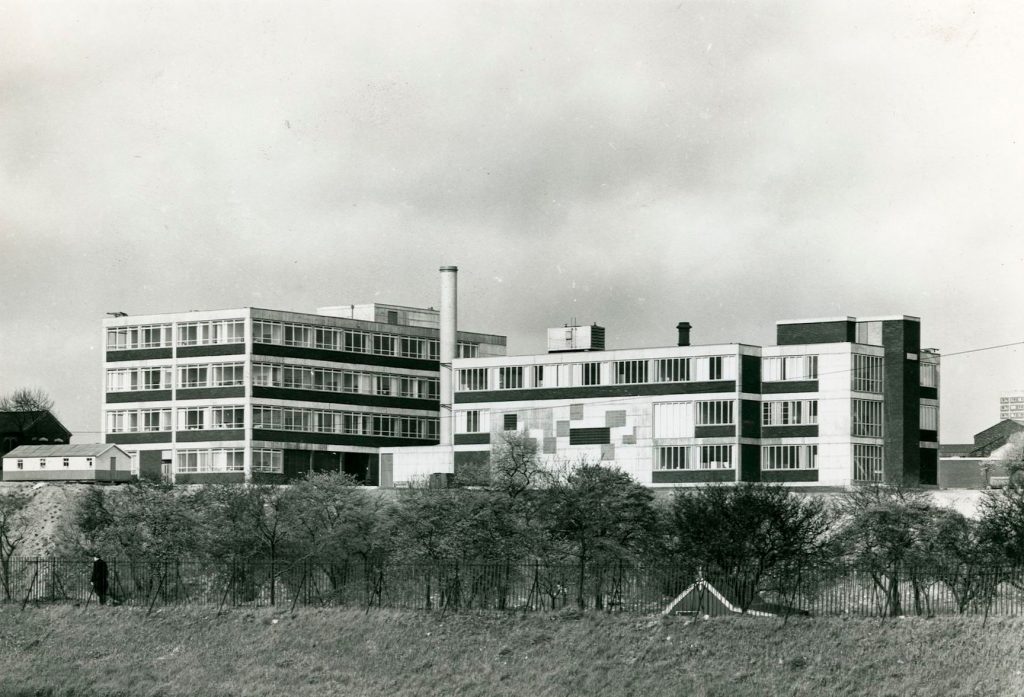
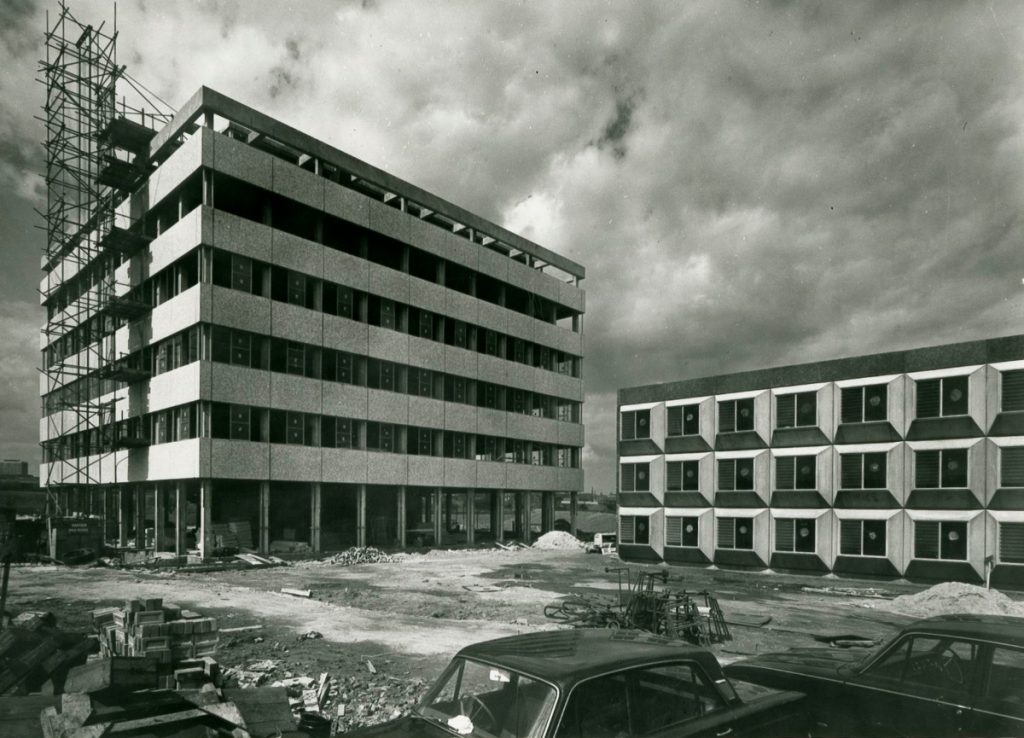
Birks also contrasts the “new universities” with the former Colleges of Advanced Technology which had decades of teaching experience and established industry links. By the time he was writing, Salford had received its Royal Charter and was operating from the modern surroundings of the Maxwell Building, while its campus was undergoing rapid expansion through its second major masterplan. These colleges became universities themselves, but with far less opportunity for architectural innovation. In comparison, the new universities had greater freedom to experiment, introducing modern designs and curricula aligned with contemporary pedagogical thinking.
Birks offers a detailed architectural perspective on the founding of the seven new universities, capturing their distinctive designs and functions, and highlighting how modernist architecture influenced student and community experiences.
Birks, T. (1972). Building the New Universities. David and Charles.
[…] this period, planners increasingly promoted contemporary concepts of the collegiate campus, and models associated with many new (Plateglass) universities. The […]