Cromwell Secondary School for Girls opened on Blandford Road, Salford, in 1962. It was designed by architects Cruickshank and Seward, the Manchester practice responsible for much of the city’s post-war educational and civic building and constructed by W. Fearnley & Sons. The practice commissioned the artist Alan Boyson (1930-2018) to make an external relief mural for the northern gable. ‘The Tree of Knowledge’ (1962) was executed in concrete, ceramic and glacial pebbles excavated from the site during construction, and depicts a tree surrounded by stylised birds, including an owl of wisdom.
Believed by the C20 Society to be the only twentieth-century ceramic mural in Salford.
I arrived in 2005 to study for a BA in Visual Arts, by which time the school had closed and the building had been absorbed into the Irwell Valley campus of the University of Salford. I was living on Silk Street in Adelphi Court, a fourteen-storey tower on the far side of the River Irwell, and walked in each morning across the river, around Peel Park and down the tree lined path beside Wallness Lane which opens onto Frederick Road at a Tudorbethan park keeper’s lodge that was still occupied. From Seaford Road the route dropped into a grid of back-to-back terrace houses with the school hidden behind them, at the boundary with the main university estate, but connected to it by nothing.
Our course had the building to itself. Three floors, and for three years nobody else worked in it. Tommy, the caretaker, opened at nine and locked up at five. Bernard ran the woodwork studio, Leonard Cohen resonating around the building from his small office. The art library was fully stocked and, whenever I used it, empty; an absolute joy of solitude and wonder. Our studios and the degree show occupied the former sports hall, with its parquet floor and its full height glazing, and the terrazzo stairs, a Cruickshank and Seward signature, I admired those years without once asking who had put them there.
My work then drew on natural history. I was making sculptural pieces from pressed flowers and taxidermy, researching in the Herbarium at The University of Manchester and the degree show was taxidermy throughout. My dissertation examined the museum as an institution, and the artists, Mark Dion among them, who intervene in museum collections, storage and display in order to expose how scientific and historical authority is assembled. I was interrogating the apparatus of the vitrine from inside a building whose own significance I had not thought to question.
We graduated in 2008 and mine was the last cohort to use the building. Bernard retired that summer, the course moved, the doors were closed, Leonard Cohen silenced. Demolition followed in 2009. On 19 August of that year Boyson’s mural was listed at Grade II status by Historic England, put forward by the Tiles and Architectural Ceramics Society with support from the Twentieth Century Society and local campaigners, including the architectural historian Christopher Marsden and the Modernist Society. The list entry describes the mural as fixed to the north end wall of the former Cromwell Secondary School, “which is not of special interest”. The mural was saved; the building that had commissioned it, and for which it had been made, was not. The cleared site became a waste ground for over a decade. Now occupied by housing and the street made to carry the development is called Boyson Drive.
What the school building was came to me afterwards, from archives. I began visually researching local modernist architecture in the Salford Local History Library, and subsequently in the Cruickshank and Seward archive held at Manchester Metropolitan University Special Collections, which survives largely through the efforts of Professor Richard Brook. It was there that I found photographs of the school and learned who had designed and built it.
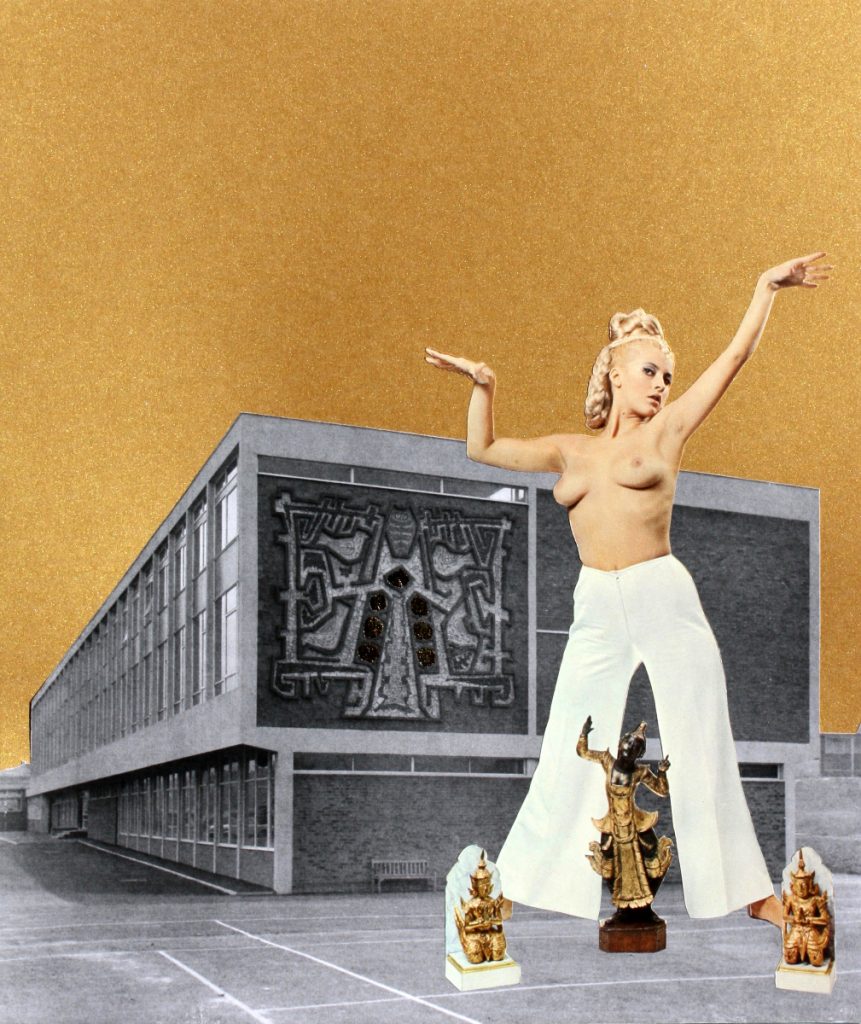
By then my practice had moved into collage. I was overlaying photographs of modernist buildings and civic redevelopment with female figures cut from vintage men’s magazines, to examine how women negotiate an urban environment designed, built and photographed almost exclusively by men. Cromwell School was a version of that proposition before I had formulated it: a school built in 1962 for girls, by men who would never use it, and occupied forty years later by a young woman training to be an artist.
In 2019 Brendan Fletcher, who taught me and still leads the course, invited me to exhibit in Fully Awake 5:6 at the Freelands Foundation, an intergenerational exhibition pairing each artist with a former tutor and a former student. The collage I made, Pursuing the Sun, was built around an archive photograph of the former Cromwell School from the Cruickshank and Seward collection, in which Boyson’s mural sits at the centre; Boyson himself a former lecturer in art at the Wolverhampton College of Art. The building had been demolished for a decade. And it had taken me that long to see it.
Sarah Hardacre is a Manchester-based visual artist, printmaker and cultural producer. Alumna of the University of Salford’s School of Art, today part of the Salford School of Arts, Media and Creative Technology, Sarah studied Visual Arts between 2005 and 2008. She is represented by Paul Stolper Gallery, London. Sarah on Instagram.
Boyson’s second surviving work in Salford is a precast concrete screen at Pendleton Sixth Form College, constructed in 1964 as part of the building’s southern elevation. Measuring approximately 7 m × 4.88 m, the screen is part of a wider decorative scheme that originally included two concrete screens and internal ceramic tiles. One screen survives today. Boyson produced a large abstract fibreglass sculpture for Swinton Precinct, opened in 1969, although lost today. The surviving Pendleton work is currently not listed. The Marvel From Marple exhibition exploring the life, work & legacy of Marple born artist Alan Boyson, is running until 30 September at Stockroom, Stockport.
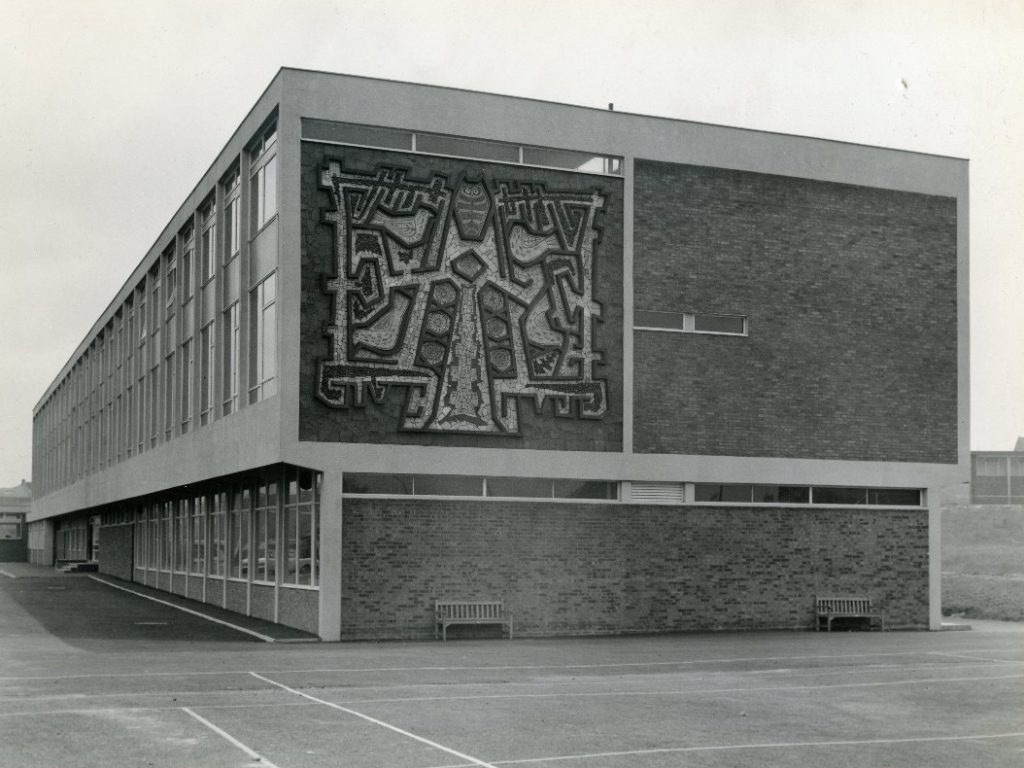
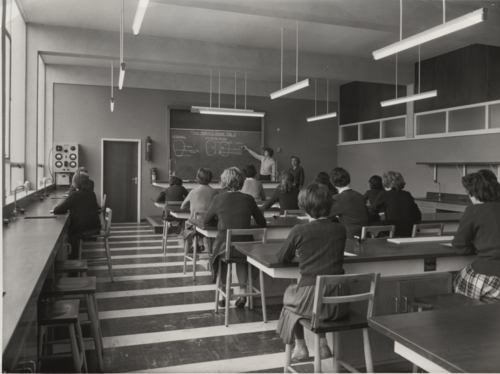
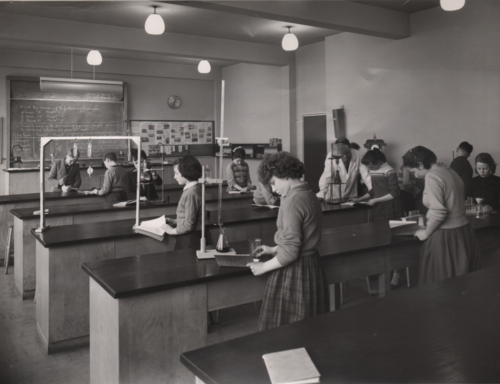
Cromwell Road School for Girls, c.1965. Salford Local History Library Collection (PF00128).
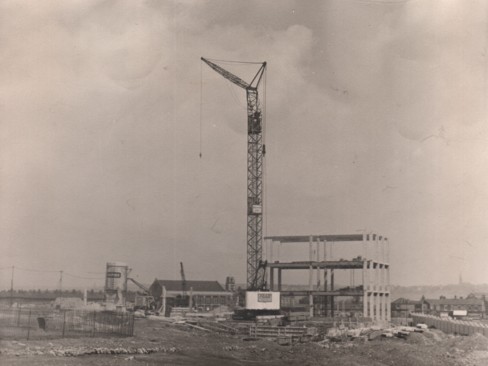
The start of the Cromwell Secondary Modern School, the site overlooking the site of an old farm adjacent to Gerald Road and Blandford Road. Salford Local History Library Collection (JW02145).
Read more from Guest Writers