In 1951, Britain presented itself as a nation looking confidently towards the future. Six years after the Second World War, reconstruction was still underway, rationing remained in place, and cinema and theatre audiences stood for the national anthem. Many communities continued to live with physical and economic consequences of conflict. The Festival of Britain was conceived as a response, an optimistic vision of national renewal through science, design, industry and education.
King George VI opening speech formally presented the Festival as a celebration of Britain’s resilience and a statement of confidence. Although now most closely associated with London’s Southbank Centre area, the Festival reached communities across the country through a programme of regional events, exhibitions and cultural activities. Centred on a large redeveloped site alongside the River Thames, the exhibition had futuristic architecture, innovative displays and powerful symbols of modern Britain. Yet the Festival was never intended to be confined to the capital. Alongside were arts festivals, regional celebrations, the exhibition ship Campania, and perhaps most ambitious, the Land Travelling Exhibition.
Touring across the country’s towns and cities, the Land Travelling Exhibition visited Manchester’s City Exhibition Hall, Leeds, Birmingham and Nottingham. At 35,000 sqf, it was the largest transportable exhibition produced in Britain. Housed within a specially designed metal and canvas structure, were 5,000 exhibits, and illumination created by powerful searchlights visible from afar. Designed as educational and entertaining, the exhibition showed how science, technology and modern design could improve everyday life. Visitors passed through a series of themed displays including Materials and Skill, Invention, Discovery and Design, People at Home, People at Play, People at Work and People Travel. Exhibits ranged from industrial design and domestic furnishings to models of jet aircraft, railway carriages and modern transport systems. Organisers promised visitors “the best of current production”, presenting a vision of a nation transformed through knowledge, innovation and technological progress. During the exhibition’s visit at (today’s) Campfield Exhibition Centre, a Manchester Guardian reporter described the experience as “Britain as it might be”. This was the central purpose; rather than celebrating Britain’s past, the exhibition encouraged visitors to imagine the future. A vision built upon expertise, invention and education, with ideas resonating across the wider city with a Womens’ Week Exhibition, the Free Trade Hall’s re-opening notice, and the City Mayor attending a special Festival of Britain Service at Albert Hall on Peter Street.
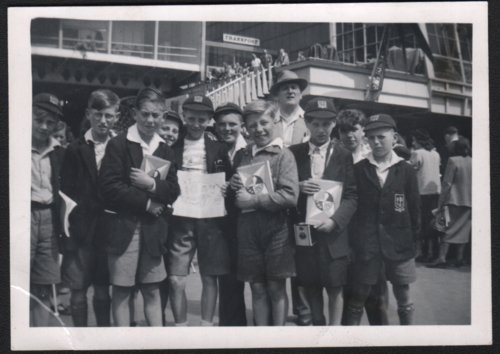
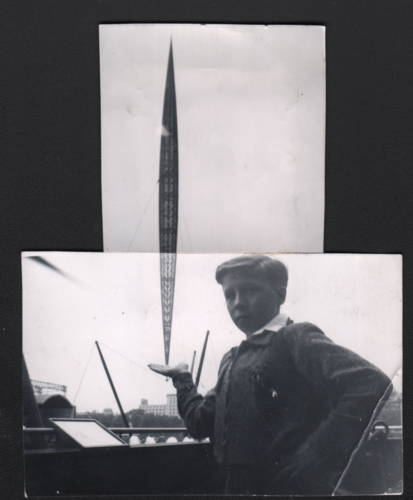
In Salford, a decade before the construction of the Maxwell Building, at the Royal Technical College, Principal Dr Venables remained committed to promoting the institution despite increasing pressures on accommodation and resources. His ambitions extended into the city’s wider civic and cultural life, with the College getting involved in regional activities linked to the Festival. Academic departments contributed material to public exhibitions including Salford Education Week and the Royal Technical College Salford Exhibition. Displays highlighted the role of education within post-war Britain and demonstrated how technical and professional training contributed to national recovery. At a time when governments, local authorities and educational institutions were increasingly concerned with economic development and industrial productivity, the College positioned itself as an active participant in influencing Britain’s future. Archival photographs show exhibits designed by the School of Art, an exhibition stand with the slogan: ‘From Learning to Earning’. Simple, memorable and revealing, the phrase connected education with employment, prosperity and opportunity. The College’s participation showed how educational institutions were increasingly drawn into national conversations around economic progress and growth. Meanwhile, at Leaf Square, pupils of Salford Grammar School visited the Festival as part of their summer camps, with one extremely talented lad even balancing the Skylon on the palm of his hand (see below)!
Festival architect H. T. Cadbury Brown saw the Festival as: “a new dawn”, an opportunity to enjoy life on modern terms through modern technology. Whether such optimism was fully realised is open to debate (certainly across Salford’s working class communities). For many families, the realities of post-war austerity remained ever present. Yet the Festival’s significance lay as much in its aspirations as its achievements. It articulated a belief in education, science and industry working together to create new opportunities and a better future. Whilst much of the Festival focused on science and technology, the arts were equally important. Architects including Sir Hugh Hugh Casson (1910-1999), Sir Robert Matthew (1906-1975), Frederick Gibberd (1908-1984), Jane Drew (1911-1996), Maxwell Fry (1899-1987), and Sir Misha Black (1910-1977) created many of its most recognisable buildings and exhibitions. Festival Director Sir Gerald Barry claimed modern architectural projects required collaboration between scientists, sociologists, painters and sculptors alike. An array of artists and designers included Barbara Hepworth (1903-1975), Lynn Chadwick (1914-2003), Lucienne Day (1917-2010), Abram Games (1914-1996) and Eduardo Paolozzi (1924-2005) each contributing to an optimistic and innovative visual culture.
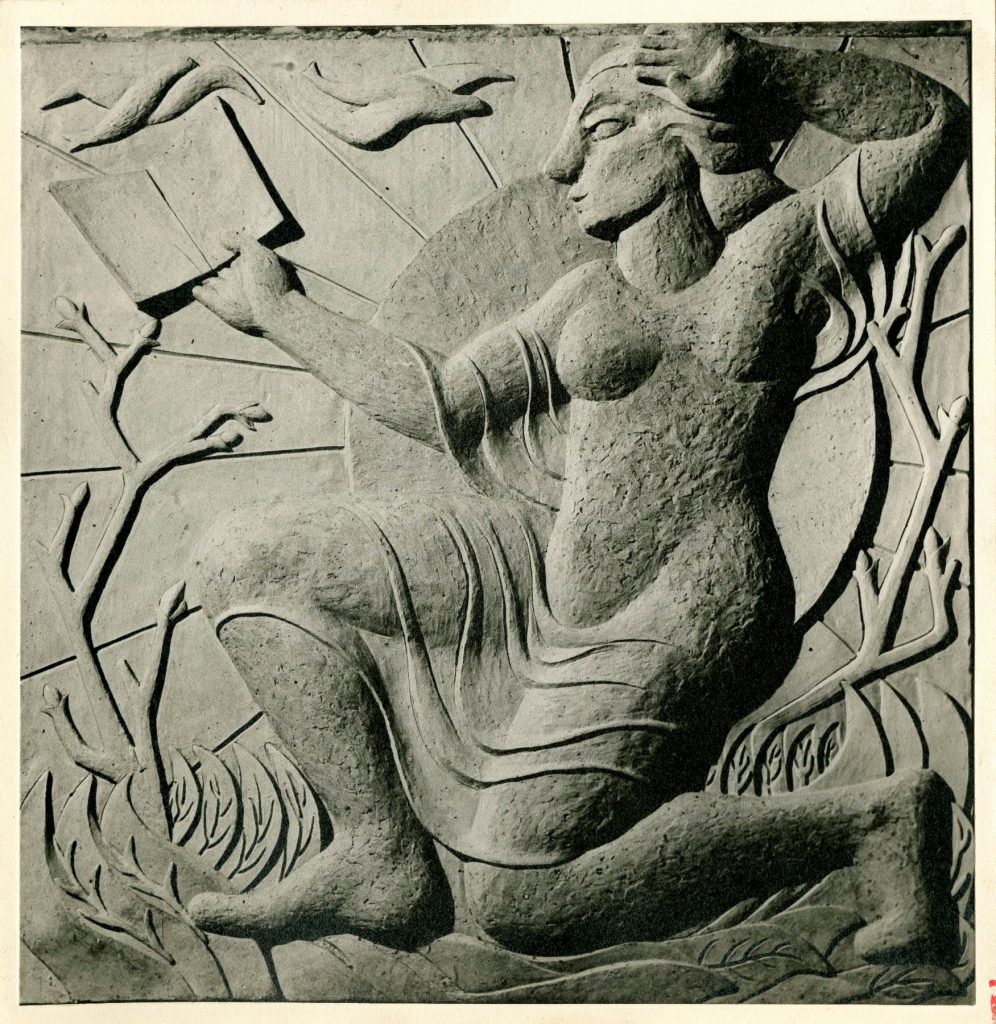
A current display in the Sculpture Research Library at the Henry Moore Institute in Leeds uses the Archive of Sculptors’ Papers to consider what was built and what was destroyed, revealing how the archive preserves the Festival’s temporary sculptural landscape. After the Festival concluded, the site was cleared and not all of the art survived. The display brings together photographs of sculpture in production and on site, sketchbooks, ephemera, and a maquette for Miranda by Arthur Fleischmann (kindly loaned by Leeds art Gallery), the whereabouts of whose full-scale bronze version remains unknown. Closer to home, we can also be thankful for Eccles-born sculptor John Milne (1931-1978). His low-relief sculpture, Minerva (the Roman goddess of wisdom) was commissioned through a Lancashire County Council competition intended to integrate public art into the modern architectural design of Summerville Primary School in Irlams o’ th’ Height, reflecting similar aspirations of the Festival.
Thanks to Lisa Brown at the HMI for supporting details and information. More reading: Historic England.
Display and exhibition stands designed in the School of Art for Education Week display, 1951. Dominated by the title Under 5 Years: Living and Learning, the display traces a child’s journey from home to nursery. Rendered in mid-century modern style, the panels use simplified figures, geometric forms, and carefully composed scenes to illustrate learning through play and experience. They reflect exhibition graphics, murals and signage associated with the FoB. The nursery furniture, toys, and activity areas in the foreground reinforce contemporary ideas about child-centred learning, welfare, and social development.
Chemistry department open day, 1951