Originally conceived as a dedicated computing centre, the Gilbert Rooms goes a little unnoticed.
However, this building represents an important stage in the University of Salford’s growing emphasis on science, engineering, and technological education. A time when universities integrated advancing tech into teaching, research and administration.
Designed by the Lancashire County Architects Department, the final perspectives and technical drawings were completed in October 1961. Construction followed shortly after the completion of Maxwell Hall. The facility initially housed an English Electric KDF9 computer, one of only a limited number of such machines installed in British colleges and universities during the period. The KDF9 was regarded as one of the most advanced British-built computers of its generation and enabled increasingly sophisticated scientific and mathematical programmes to be undertaken across multiple disciplines. The computing centre remained operational until the early 1980s, while the wider building continued to support computing activities until 1974, when operations were transferred to the Bridgewater Building on the former Meadow Road Campus.
Salford’s growing investment in computing was reinforced following the Flowers Report (1965) which examined the future of university computing provision. As part of a national programme of technological modernisation, Salford was one of seven British institutions to receive support from the Atomic Energy Authority for major computing upgrades, alongside Birmingham, Glasgow, Leeds, Liverpool, Nottingham, and Oxford. The funding contributed towards memory expansions, increased storage capacity, additional magnetic tape stations, and the installation of random-access disc technology capable of storing more than 30 million characters. These developments expanded computational capabilities and reinforced Salford’s reputation as an institution in applied science and technological innovation.
Architecturally, the Gilbert Rooms adopted a restrained and modest appearance. Unlike the larger civic confidence expressed through neighbouring Maxwell Hall, the building functioned as a highly specialised technical facility. Constructed using prefabricated concrete pebble-dash panels, the structure was designed as a compact rectangular form with a near-flat roof and projecting concrete pilaster columns that subtly referenced early International Style principles. The eastern elevation presents the appearance of a single-storey structure, although the building is partially elevated above a lower-ground service area concealed beneath the main floor level. Several architectural details softened the otherwise utilitarian character. A cantilevered concrete staircase created the impression of a floating flight of steps leading towards the entrance, while circular concrete planters introduced a quiet ornamental quality. Internally, the building’s specialist infrastructure included air-conditioning units, acoustic wall panels, editing rooms, storage areas, and staff facilities, to meet the technical demands of the time.
Reconfigured in 1990 as a general teaching space, the building was subsequently renamed the Gilbert Rooms. The name commemorates two figures associated with scientific and engineering advancement: William Gilbert (1544-1603), recognised for his pioneering studies of magnetism, and John Gilbert (1724-1795), the engineer associated with the construction of the Bridgewater Canal. More Buildings
Gilbert Rooms
Address: University of Salford, Peel Park Campus, The Crescent, M5 4QW. Construction: 1962-1964, designed from 1960. Architect: Lancashire County Council’s Architects’ Department, under the direction of the County Architect, C. H. Simmons. Scheme: Phase III, Comprehensive Development Plan (1961). Royal College of Advanced Technology, Salford. Assistant Architect: D. R. Holloway.
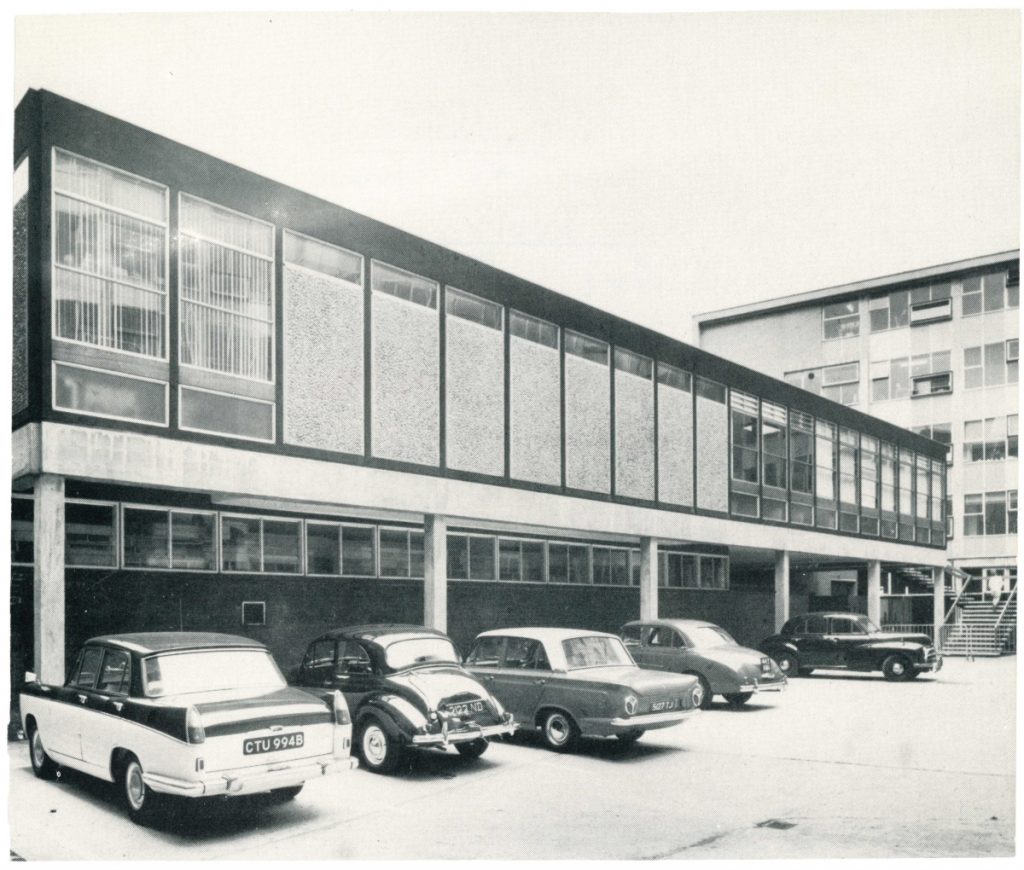
Computer Centre, Royal College of Advanced Technology, Salford, c1966 . Image: Salford Local History Library Collection.