Salford’s first vision for expansion.
By 1950, the Royal Technical College, Salford was at a critical development point with increasing student numbers and evolving disciplines. Today’s Peel Building, designed by Henry Lord in 1896 couldn’t meet the demands of a rapidly changing educational landscape. Expansion was essential, but a question remained: in what form and how would this look?
The intial answer was ambitious..
Presented in January 1950 by the Lancashire County Council Architects’ Department under County Architect G. Noel Hill, the first approved scheme for extending the College proved to be dramatically different vision to the campus we know today. Rather than the Maxwell Building completed a decade later, the original design put forward a bold five-storey structure overlooking Peel Park, combining civic authority with a newfound air of post-war modernism.
At the centre of the proposal is a prominent tower and cylindrical stairwell, architectural features that projected confidence and modernity. Long horizontal window bands, clean geometric forms and smooth stone façades created a building that was clearly forward-looking, yet still respectful of the surroundings. The design attempted to balance The Crescent’s established civic character, with contemporary architectural ideas then beginning to influence educational buildings across Britain. This was no accident. Governors and planners were keen that any new development should sit comfortably alongside landmarks such as the Salford Museum and Art Gallery, the former Christ Church, Jubilee House (now the Working Class Movement Library), and the wider Georgian and Victorian townscape. A fascinating result, transitional, neither fully traditional nor fully modern. A crossroad.. right for Edwardian civic classicism, or left for European modernism.
Yet the scheme was short-lived. In 1951, the Ministry of Education issued Building Bulletin No. 5, introducing new standards and expectations for educational architecture. Flexibility, efficiency, and specialised teaching spaces became increasingly important. As plans progressed to meet changing educational needs and government guidance, the original concept was progressively revised and modernised. Features intended to create visual harmony with neighbouring buildings were gradually abandoned in favour of a more overtly functionalist approach. Although never realised, the 1950 model is an important part of the University of Salford’s story. The County Architects’ design acknowledged the College’s nineteenth-century origins while looking towards an uncertain modern future. More than simply an unrealised proposal, it represented the first serious attempt to imagine a new identity for an institution on the cusp of major expansion.
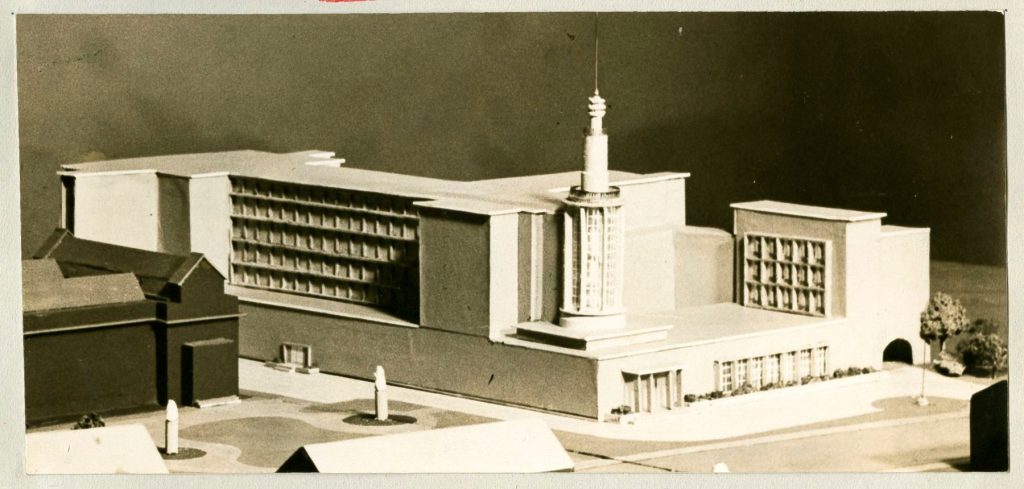
Scale block model of provisional idea for new college extension building, 1950. Lancashire County Council Architects’ Department under County Architect G. Noel Hill.
Technical architectural elevations for extension building in c1954, Royal Technical College, Salford. Top diagram: west facing the Museum and Art Gallery; bottom left diagram: south facing The Crescent; bottom right diagram: north facing Peel Park.