The Maxwell Building signified a new found confidence for the College, sector and society.
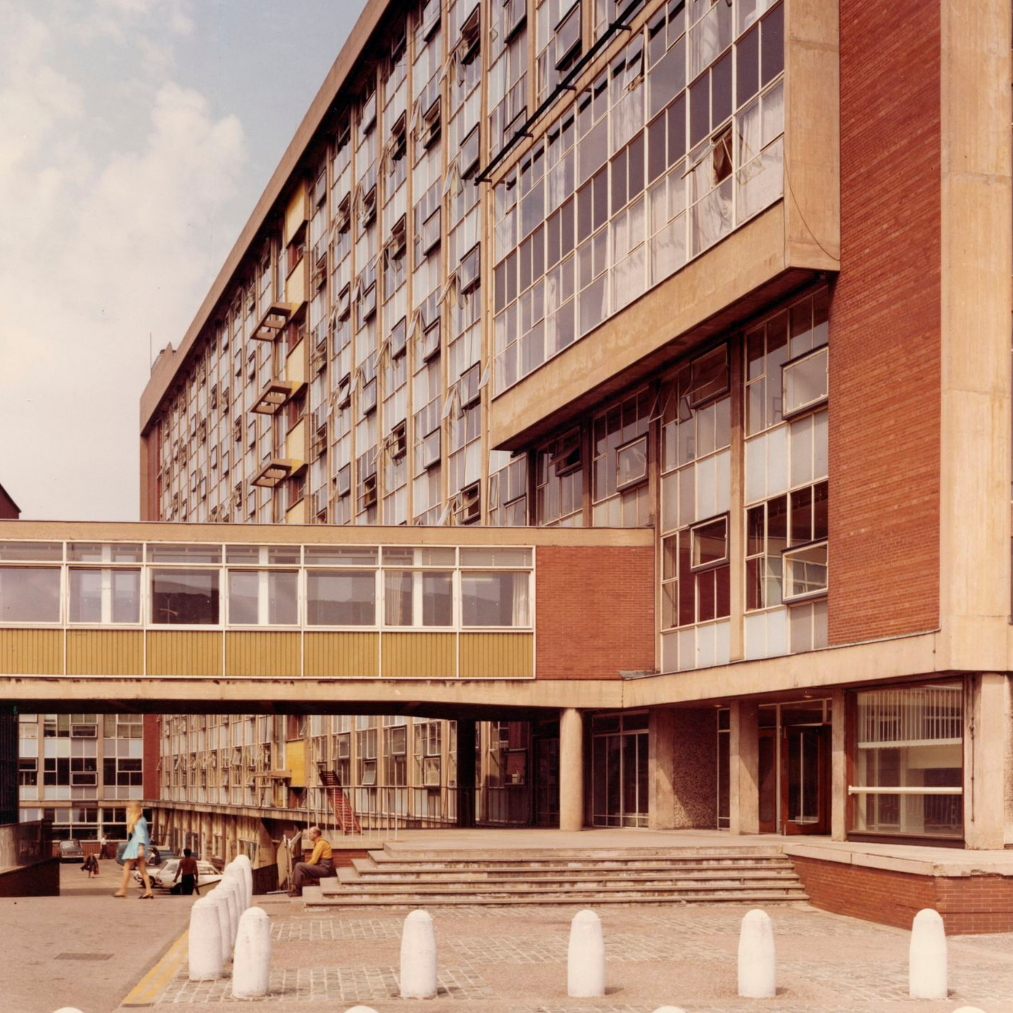
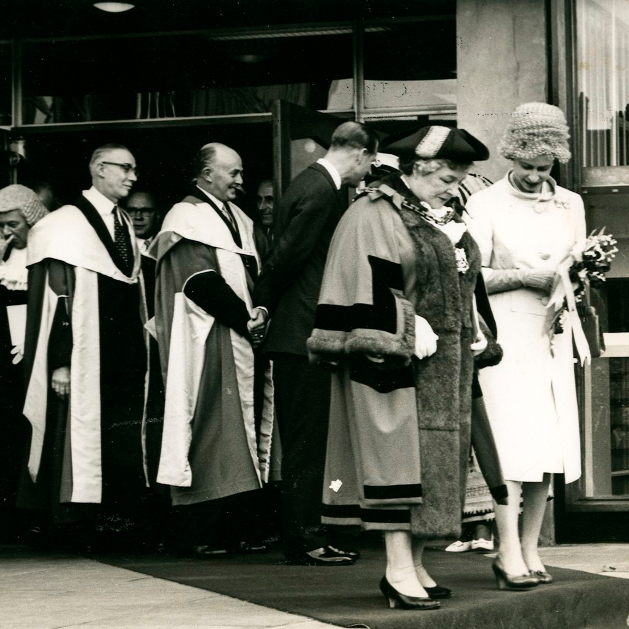
The new building for the Royal College of Advanced Technology, Salford, captured a moment of growing confidence in higher education. Later renamed the Maxwell Building and Hall, it was the city of Salford’s most contemporary development, strategically located next to the River Irwell and adjacent to Peel Park. The building and hall were formally opened on Wednesday, 24 May 1961, by Queen Elizabeth II (1926-2022) and Prince Philip, Duke of Edinburgh (1921-2021). Jointly funded by Lancashire County Council and Salford City Council at a cost exceeding £1.5 million, the project demonstrated major investment in advanced technical education and modern campus planning.
Salford was among a group of Colleges of Advanced Technology, recognised for their advanced scientific and techligcal courses rogrammes operating similarly to civic universities. Government policy encouraged their clear focus on technical and scientific disciplines, prompting institutional restructuring across the sector in 1958. Salford’s newly created advanced college relocated into the modern facilities, while other courses remained in the original home (in the Peel Building). Designed to support advanced science and engineering teaching, the Maxwell Building was designed in anticipation of future campus modernisation. Continued developments incuded new halls of residence, Davy, Joule and Faraday (1964), modern computing facilities (1964), Cockcroft Building (1966), Clifford Whitworth Library (1971), Chapman Building (1972), University House (1972), and the Newton Building (1976), to name only a few.
Architecturally, the building was designed in phases by the Lancashire County Council Architects’ Department. Discussions began in 1947, with initial architectural designs developed from 1949 and the first presentation of architectural sketches and models in 1950. A Modern Maxwell that never was, the scheme failed to materialise following changes in legislation a year later. Subsequent phases were developed under County Architect George Noel Hill (Phases I and II, 1954-1958) and C. H. Simmons (Phases II and III, 1958-1961). The main Maxwell buildings adopted a distinctive L-shaped form rising to nine storeys, with contemporary references to a “superstructure” reflecting both scale and ambition. Facilities included specialist engineering laboratories, workshops, drawing offices, lecture theatres, teaching spaces, common rooms, dining areas and library provision. The adjacent Hall, connected by a bridge, contained a large lecture hall seating up to 1,000 students, alongside music rooms, a gymnasium, games areas, projection facilities and a cinema space.
The Maxwell Building embodies mid-century modernist principles, many oringating from Europe. A steel frame and precast floor system is supported by pilotis designed to address the challenging clay banks along the river. The design drew upon international style influences, inviting comparison with Le Corbusier’s Unité d’Habitation in Marseille (1952) through the integration of diverse functions within a single vertical structure intended to stimulate social interactions and communal learning. There’s even Festival Style elements, materials and finishes which nod to the 1951 Festival of Britain. During this period, planners increasingly promoted contemporary concepts of the collegiate campus, and models associated with 1960s new universities. The Maxwell Building and Hall formed central components of a broader campus masterplan that aspired to create a coherent academic environment through proximity, connectivity and shared spaces. Future expansion seen in the first masterplan, the Comprehensive Development Plan (1961). All of this was based on the extensive redevelopment around Peel Park, including the demolition of the Peel Building and Salford Museum and Art Gallery. It’s difficult to imagine the campus without these earlier structures, yet proposals to remove them illustrate ambitious scale and a forward-looking planning culture. More Buildings
Maxwell Building & Hall
Address: University of Salford, Peel Park Campus, 43 The Crescent, Salford M5 4WT. Construction: 1954-1961. Architect: The Lancashire County Council Architects’ Department. Discussion from 1947, with initial designs from 1949, the first presentation of architectural sketches, and modelling in 1950. Under County Architects George Noel Hill with respect to Phases I & II from 1954-1958; and C. H. Simmons with respect to Phases II & III, 1958-1961. Assistant Architects: G. S. Pester, J. Nicholls, C. A. Spivey, C.H. Jackson, A. Holt, D. Galloway, A. Whitehead, G. L. O. Rossant, J. A. Forbes, P. T. Renninson, A. Wilson, Stuart Alan Bulmer Heppell. Contractor: John Turner and Sons (Preston) Limited.



[…] materialisation of this visionary plan is seen today with the Maxwell Building, which officially opened in 1961 and was designed by Lancashire County Council Architects G Noel […]
[…] conclude with two images of the Maxwell Hall. The first one is a fabulous photograph shortly after it was built. This historical venue has […]
[…] actor, Brenda de Banzie (1909-1981), walking across the park’s upper south terrace, where the Maxwell Building is located today. I find this scene hard to imagine and the way this spot once looked. Those […]
[…] the university was known back then), that I came across with my MPhil. At the time, based in the Maxwell Building (1961) already offered courses in Civil, Structural, Gas, and Public Health Engineering, with […]
[…] Queen, Elizabeth II and her late husband, Prince Philip the Duke of Edinburgh formally opened the Royal College of Advanced Technology, Salford, based in the newly constructed Maxwell Building. The creation of an advanced college was part of […]
[…] a 1963 feature in Chemistry and Industry. Then, the Royal Technical College, Salford (based in the Maxwell Building) housed the department with courses in civil, structural, gas, and public health engineering, with […]