Pilgrimage tourism in Bangladesh is more than a journey of faith – it is a powerful social, cultural, and economic force. From the vast congregation of the Bishwa Ijtema in Tongi, to the sacred Hindu gathering at Langalbandh Ashtami Snan, and from Buddhist celebrations at Dharmarajika Buddhist Monastery to festivals at Buddha Dhatu Jadi, millions of people travel each year in search of spiritual fulfilment.
Yet behind these sacred journeys lies a pressing question: what is the environmental footprint of faith? Here, “environmental footprint” refers to the pressure human activities place on the natural environment, including pollution, waste, damage to ecosystems and the use of land, water and energy.
Growing tourism, growing pressure
Bangladesh’s religious tourism sector is expanding rapidly. Both domestic and international travel linked to cultural and spiritual tourism have increased in recent years. However, increased footfall at pilgrimage sites brings significant ecological strain. Unregulated crowd flows, plastic waste accumulation, freshwater depletion, biodiversity loss, and rising carbon emissions from transport and infrastructure are becoming common challenges. Sacred forests, rivers, and hills – once symbols of spiritual purity – are increasingly burdened by pollution and erosion.
A moral paradox
This situation highlights a deeper paradox. Pilgrimage traditions are rooted in humility, reverence, and moral responsibility. However, modern pilgrimage tourism is often organised in ways that prioritise economic gain over environmental and spiritual integrity.
Religious sites are not simply tourist attractions; they are living sacred spaces. When rituals are over-commercialised or heritage is treated mainly as a product to be sold, both the spiritual experience and the natural environment risk being diminished.
Faith as a foundation for environmental responsibility
Islamic teachings offer a compelling ethical foundation for rethinking these challenges. The Qur’anic warning, “Do not cause corruption upon the earth after it has been set in order” (7:56), frames environmental degradation as fasād, meaning moral imbalance or harm.
From this perspective, problems such as climate change, pollution, and biodiversity loss are not only environmental issues but ethical ones. Protecting the environment becomes an act of faith, linking spiritual responsibility directly to environmental stewardship.
Presenting at an international conference on religious tourism
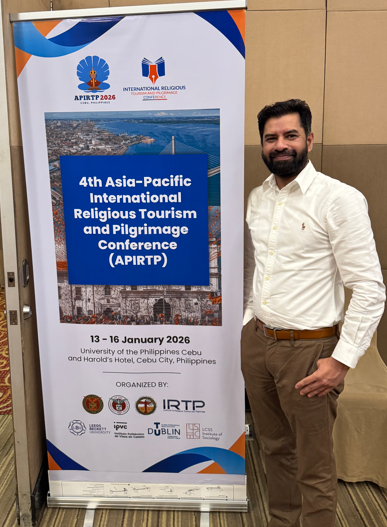
These ideas were presented by Dr Md Javed Kawsar, Lecturer in Marketing, and Dr Rashed Khan, Lecturer in International Business and Marketing, at the 4th Asia-Pacific International Religious Tourism and Pilgrimage Conference, held in January in Philippines.
The conference brought together scholars, policymakers and practitioners to explore how religion, culture and tourism intersect, with a particular focus on sustainability, heritage preservation and community participation in faith-based travel.
Pathways for sustainable reform
Addressing the environmental impact of pilgrimage tourism requires systemic change – meaning coordinated action across policies, institutions and everyday practices, rather than isolated solutions.
First, improved visitor management and waste control are essential at major pilgrimage sites. While tourist police units already play a role, many face staff shortages and limited resources. Strengthening institutional capacity and ensuring long-term funding are key steps.
Second, digital tools offer new possibilities. Smart tourism systems – such as digital ticketing, crowd monitoring, and virtual pilgrimage experiences – can help reduce physical pressure on vulnerable sites. Since the pandemic, many Bangladeshi tourists have shown growing interest in greener and more locally focused travel, creating opportunities to promote eco-friendly services and responsible tourism marketing.
Third, collaboration is crucial. Religious institutions, policymakers, private organisations, and local communities must work together to embed sustainability into pilgrimage planning. Faith-based environmental messaging can encourage responsible behaviour, while involving local communities helps protect both cultural heritage and natural landscapes.
Looking ahead
Bangladesh stands at a crossroads. Pilgrimage tourism can either deepen environmental degradation or become a model of spiritually grounded sustainability. By reframing religious travel through an ecological lens, there is an opportunity to harmonise sacred journeys with environmental integrity – ensuring that faith leaves not a scar, but a legacy of stewardship.