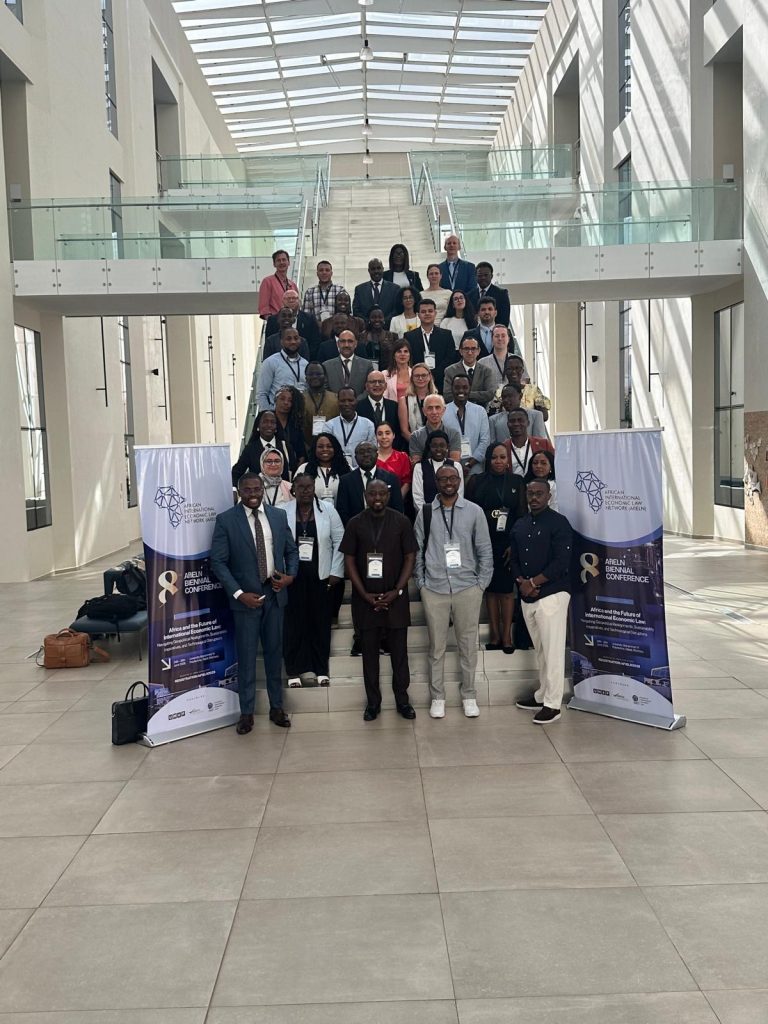
Salford Business School’s Lecturer in Law, Dr Tracy Boahene, recently had the privilege of presenting her research at the 8th Biennial African International Economic Law Network (AfIELN) Conference, hosted by Mohammed VI Polytechnic University in Rabat, Morocco.
Bringing together academics, practitioners, policymakers and researchers from across Africa and beyond, the conference explored the theme, “Africa and the Future of International Economic Law: Navigating Geopolitical Realignments, Sustainability Imperatives, and Technological Disruptions.” It provided an important platform for examining how contemporary geopolitical, economic and technological developments are reshaping international economic law and the role of African actors within this evolving landscape.
Highlights from the conference
One of the conference’s highlights was the opening plenary commemorating the 50th anniversary of the call for a New International Economic Order (NIEO). Chaired by Professor Leïla Choukroune, the panel featured distinguished scholars, including Professors James Thuo Gathii, Muthucumaraswamy Sornarajah, Emmanuel Laryea and Suresh Nanwani, alongside Dr Harrison Mbori. The discussion reflected on the continuing relevance of the NIEO in a world characterised by geopolitical fragmentation, economic inequality and renewed debates concerning sovereignty, development and international cooperation.
Rather than treating the NIEO as a historical project, the panel explored its contemporary significance and asked whether current global realignments create new opportunities for Africa and the wider Global South to shape international economic governance. The discussion highlighted the growing importance of African perspectives in debates concerning trade, investment, sustainability and global economic regulation. These themes resonated throughout the conference and provided a valuable backdrop for the presentations and discussions that followed.
Tracy’s research
Against this backdrop, Tracy presented her paper, “Enforcement of Investment Arbitral Awards in a Fractured Global Order: Sovereignty, Indigenous Rights, and the Limits of ISDS.”
The paper examines a critical but often overlooked aspect of international economic law: the enforcement of arbitral awards. Traditionally, enforcement has been viewed as a largely technical process that follows the resolution of an investment dispute. Tracy’s research challenges this assumption by arguing that enforcement has increasingly become a site of contestation within international economic law.
The paper explores how contemporary geopolitical fragmentation, renewed assertions of state sovereignty and the growing influence of constitutional, environmental and indigenous rights frameworks are reshaping the enforcement landscape.
Governments are increasingly seeking greater regulatory autonomy to pursue legitimate public policy objectives, including environmental protection, climate action and the protection of community and indigenous rights. As a result, states are increasingly invoking constitutional principles, public policy considerations and human rights obligations when responding to investment arbitral awards.
Tracy argues that these developments reflect more than isolated instances of resistance or non-compliance. Rather, they reveal broader structural tensions within the investor–state dispute settlement (ISDS) regime and raise important questions about its legitimacy, resilience and future direction.
Drawing on examples from both Europe and the Global South, including African jurisdictions, the paper examines how states are seeking to reconcile investor protection with competing commitments to sovereignty, sustainable development and social justice. In this context, African states are not merely responding to changes in international economic law; they are increasingly contributing to its reform and evolution.