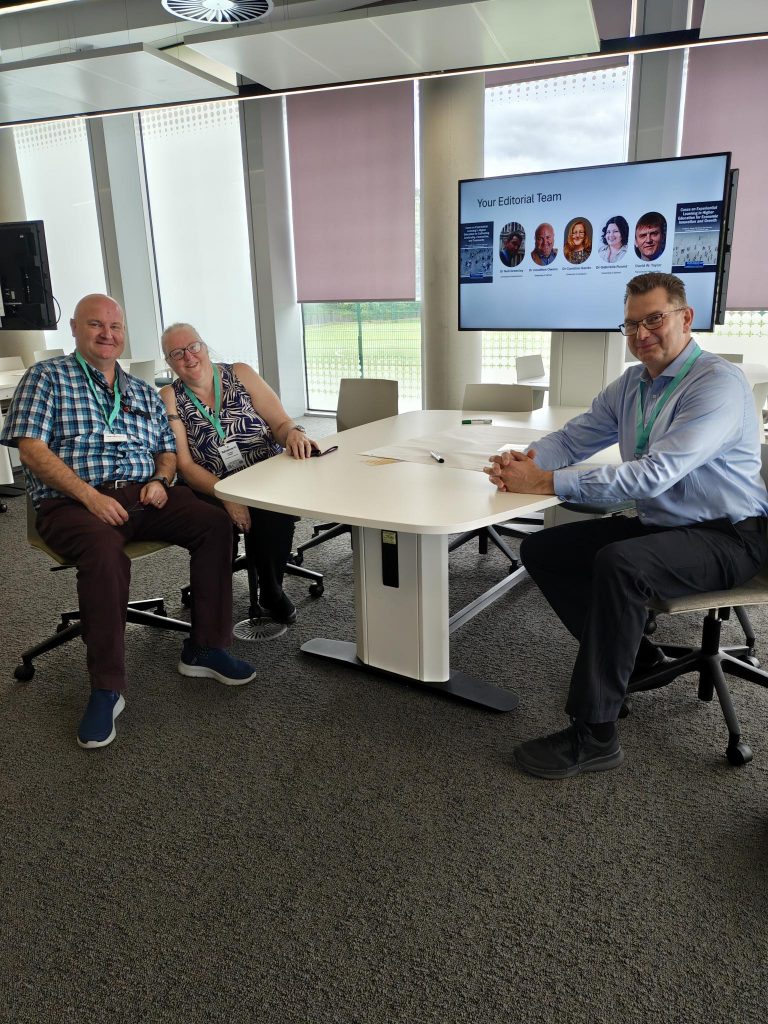
Dr Jonathan Owens, Senior Lecturer here at Salford Business School, recently attended Advanced HE’s (Higher Education) flagship Teaching and Learning Conference as part of a collaborative project involving the Universities of Liverpool, Hertfordshire and Manchester Metropolitan.
This was held from 30 June to 2 July 2026 at The Wave, University of Sheffield, and brought together educators, institutional leaders, researchers, and professional services staff from around the world to explore the latest developments in higher education teaching and learning.
The three-day event provided an inspiring programme of keynote presentations, workshops, and interactive sessions focused on innovation in learning and teaching, student success, assessment, curriculum design and the future of higher education. It also offered valuable opportunities to network with colleagues from across the sector, share best practice, and discuss emerging challenges and opportunities.
Sharing experiential learning: from classroom innovation to global educational practice
Higher education is rich with innovative teaching practices that transform student learning. Yet many of these powerful examples remain confined to individual classrooms, programmes or institutions. What if these experiences could become shared resources that inspire educators around the world?
This question lay at the heart of Jonathan’s interactive workshop, “Co-designing a Global Experiential Learning Casebook: A Live Author–Editor Simulation with Call for Papers.” Bringing together educators, researchers and practitioners, the workshop demonstrated that publishing educational practice does not have to be an intimidating process. Instead, it can be collaborative, reflective and deeply rewarding.
Why experiential learning and enterprise education matter in higher education
Experiential learning has become a cornerstone of contemporary higher education. Through enterprise projects, simulations, mentoring, coaching, work-based learning and community engagement, students develop knowledge by actively engaging with authentic experiences and critically reflecting on them. These approaches help bridge the gap between theory and practice while developing the professional capabilities increasingly valued by employers and society.
The workshop highlighted how experiential learning and enterprise education (EntEd) are embedded across diverse educational contexts. Examples ranged from PG (postgraduate) programmes integrating strategic business simulations to enterprise initiatives that guide students through the complete entrepreneurial journey, from opportunity recognition and idea generation to launching, managing and evaluating a business venture. These examples illustrate that meaningful learning occurs when theoretical concepts are intentionally connected with authentic practice.
On the conference and his workshop, Jonathan commented: “What became particularly evident through discussions with workshop participants, as well as through related conference presentations, was the breadth of innovative experiential and enterprise education approaches currently being implemented across higher education. Educators are increasingly adopting multiple pedagogical strategies to simulate professional and real-world environments, enabling students to engage in authentic problem-solving, collaborative decision-making and reflective practice.
“These conversations reinforced one of the workshop’s central messages: while experiential learning and enterprise education are flourishing across disciplines, many of these innovative practices remain undocumented and inaccessible to the wider higher education community.
“By encouraging educators to publish and share their experiences, we can build a collective evidence base that showcases effective practice, supports scholarly dialogue, and inspires innovation across institutions. A global casebook offers an opportunity to transform individual teaching innovations into shared educational resources that can inform, challenge and inspire educators worldwide.”