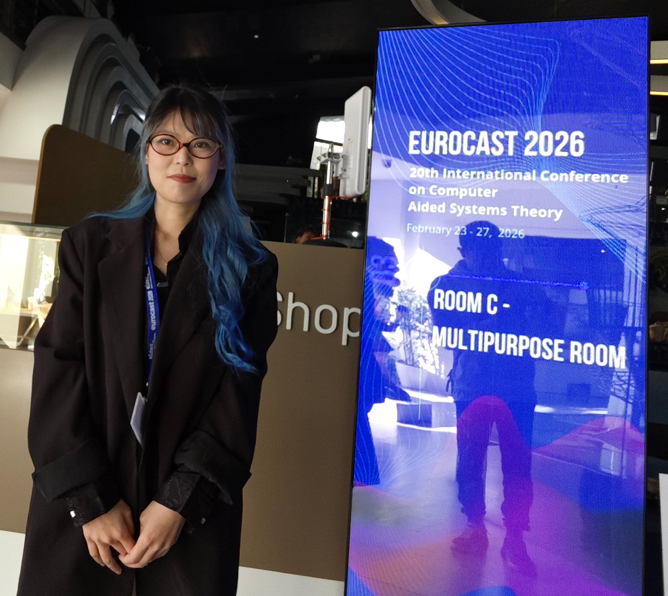
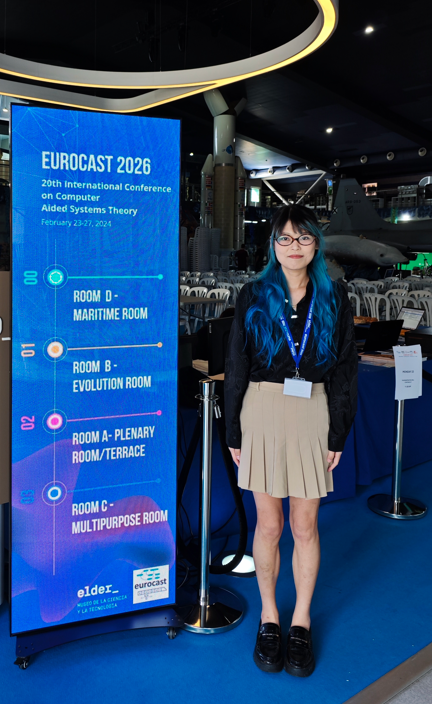
At Eurocast 2026, held at Museo Elder de la Ciencia y la Tecnología in Las Palmas de Gran Canaria, Spain, Dr Kate Han, Lecturer in Information System and Digital Business, presented three papers on applied machine learning and optimisation across higher education, transport systems, and healthcare scheduling. These papers are collaborative works, developed with colleagues from various Salford Business School subject groups and external partners from Robert Gordon University in Aberdeen, the National Technical University of Athens, and PolyShape Ltd.
The first paper, Applying Machine Learning and Automation to Enhance Student Support in Higher Education, explores how predictive analytics and automation can be embedded into institutional processes. It integrates supervised learning with rule‑based automation to identify the right timing for early student support, improving the teaching and learning experience in Salford Business School. The focus is on transparent, auditable, and well‑integrated system architecture rather than model accuracy alone. The aim is practical impact -combining educational expertise with digital transformation so staff can focus on meaningful student support instead of routine administrative tasks.
The second paper, Investigating Greater Manchester Tram Service Optimisation Using a Multi-Layer Transport Library Simulation Approach, investigates how the existing Metrolink transport network can be extended to better align with the local authority’s city‑design and optimisation goals. It demonstrates how artificial intelligence (AI) can support rapid prototype solution generation, providing policymakers with evidence‑based options for decision‑making. The work highlights how combining AI, simulation, and optimisation methods can maximise their benefits in urban regeneration and strategic transport planning.
The third paper, A Learning-Embedded Hyper-heuristic Framework for the Integrated Healthcare Timetabling Competition 2024, introduces an adaptive reinforcement learning multi agent hyper‑heuristic framework designed for complex real world scheduling tasks. The framework incorporates a learning mechanism that dynamically selects heuristics based on problem landscape and search performance. Its broader contribution is to bridge the gap between research and real‑world problem solving by supporting efficiency improvements, reducing administrative burdens in the healthcare system, and enabling practitioners to refocus on delivering high‑quality patient care.
This year marks the 20th edition of Eurocast conference, a long‑running research event that brings together worldwide researchers from a wide range of disciplines to explore how computer science and AI intersect across diverse application areas. Its continued growth highlights the expanding influence and collaborative nature of the field. Presenting work at Eurocast helps extend the research impact of Salford Business School and contributes to strengthening its international reputation.