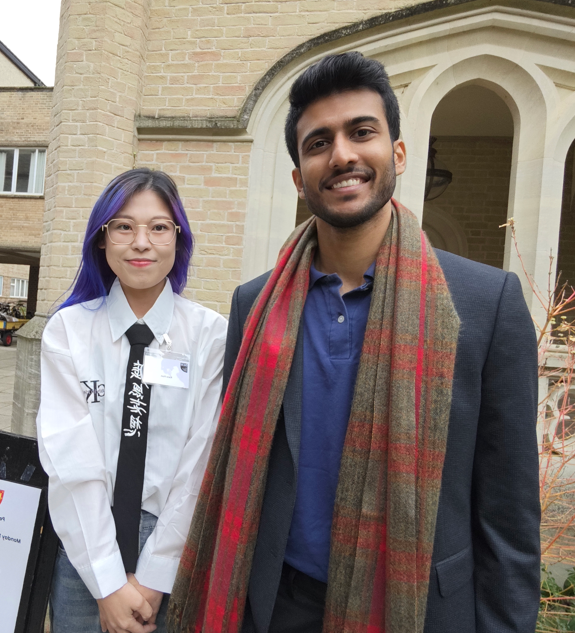
Dr Kate Han, Lecturer in Digital Business at Salford Business School, recently presented two conference papers at the 45th SGAI International Conference on Artificial Intelligence (SGAI, AI 2025), held at Peterhouse College, University of Cambridge.
The conference is organised by the British Computer Society’s Specialist Group on Artificial Intelligence and brings together researchers and practitioners working on both technical AI methods and applied systems. Alongside paper presentations, the event provided space for discussion around how AI research is being used in practice, particularly in public services, education, and transport.
About the research
The first paper, ‘Carbon Crest: a personal carbon credit model for sustainable transport behaviour in Greater Manchester’, looks at how personal carbon credits could be used to encourage more sustainable travel choices. The work focuses on everyday behaviour, such as switching from car use to public transport, and how carbon savings from these changes can be calculated at an individual level. The paper presents a simulation model that tracks travel behaviour and assigns carbon credits accordingly. The aim is to provide a practical option for local and regional decision makers who are exploring ways to support behaviour change and meet climate targets.
The second paper, ‘Exam timetabling problem using cooperative hyper-heuristics’, focuses on a well-known scheduling problem in higher education. The research proposes a cooperative approach where multiple heuristic strategies work together rather than in isolation. When tested on the ITC2007 benchmark dataset, the method produced strong results across a range of problem instances. While the case study in exam timetabling, the approach is relevant to other scheduling and planning problems where time and resources are limited.
Key takeaways from the conference
One clear theme across the conference was the focus on methods that work under real constraints, rather than ideal conditions. Many papers emphasised robustness, simplicity, and the ability to apply research outside the lab. There was also strong interest in how technical work connects to policy, operations, and day-to-day decision making.
Looking ahead
Presenting at SGAI-AI 2025 was a useful opportunity to share work, receive feedback, and connect with researchers working on similar practical problems. Both papers contribute to ongoing research at Salford Business School into using AI methods to support sustainability, planning, and operational decision making in realistic settings.