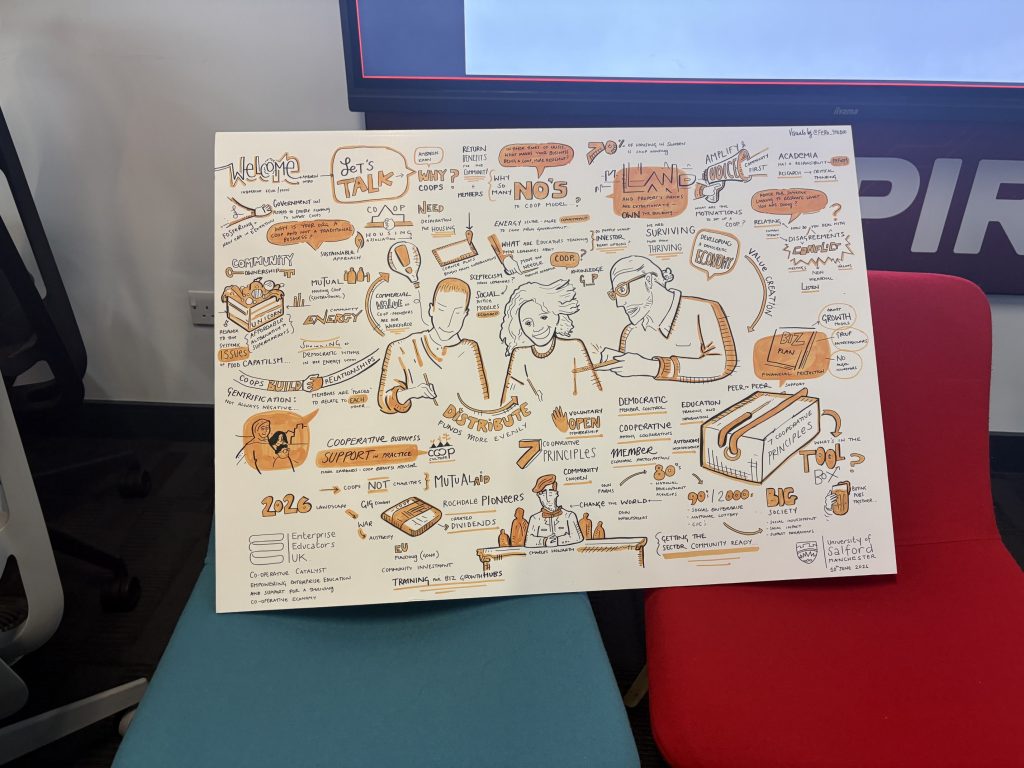
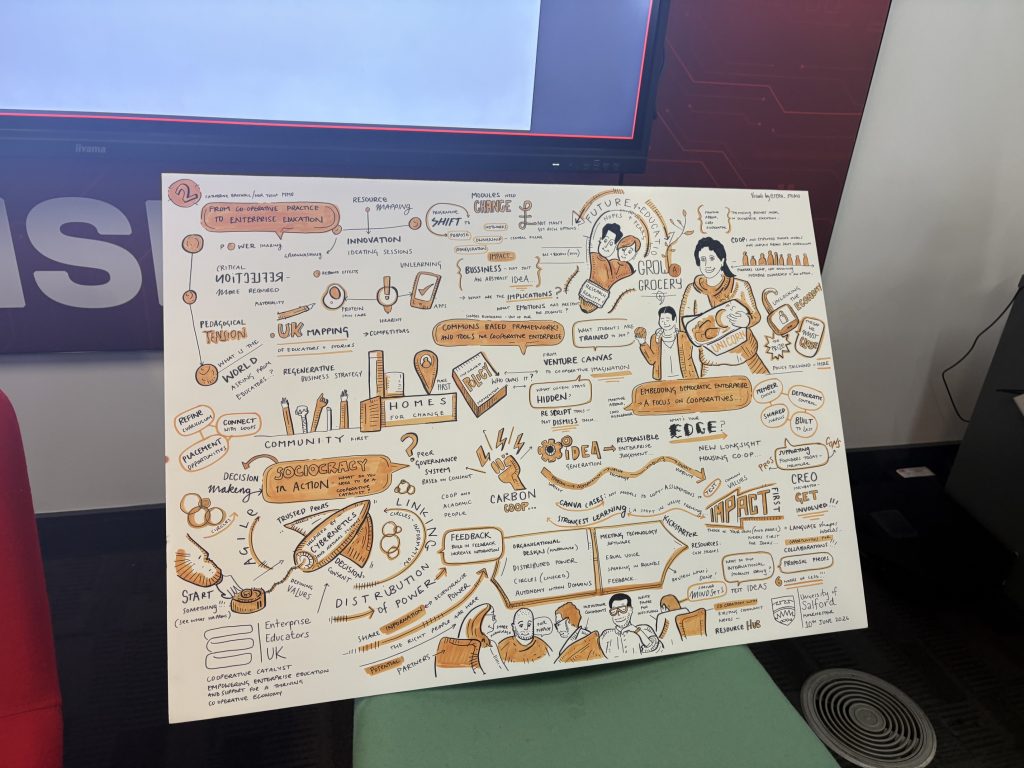
Earlier this month, Salford Business School colleagues were joined by peers from across the sector as we played host to Enterprise Educators UK’s (EEUK), Enterprise Exchange event, titled ‘Co-operative Catalyst – Empowering Enterprise Education and Support for a Thriving Co-operative Economy.’
This event presented a great opportunity for colleagues to connect with others interested in advancing co-operative enterprise education, while enabling attendees to explore how we might collectively address some of the structural gaps in current enterprise narratives.
Building on conversations from last year’s International Entrepreneurship Educators Conference, around the role of co-operative business in addressing inequality, democratic participation and sustainability, the event brought together educators from across the sector with the goal of strengthening connections across the community. It also sparked valuable conversations about how universities can play a more active role in developing the next generation of co-operative entrepreneurs.
Dr Ambarin Khan, Salford Business School’s Programme Lead for MSc Entrepreneurship and Innovation, who helped lead the event on behalf of the University, commented: “At a time when it’s critical for universities to generate start-up activity and contribute to economic growth, educating students on co-operative models that place collaboration, shared ownership and social value at their core, offers an opportunity to cultivate more inclusive, resilient and sustainable forms of entrepreneurship.
“In doing so, universities have the opportunity not only to produce the next generation of founders, but to nurture a generation of changemakers capable of building businesses that are commercially successful, socially impactful and rooted in the communities they serve.”
Panellists during the event, who were able to share first-hand experiences as co-operative enterprises, along with their impact on areas such as housing, food and energy, included: Debbie Clarke from Unicorn Grocery, Sean Farmelo from Stirchley Community Housing, Keith Underhill from Homes for Change, Kelly Jayne Jones from New Longsight Housing Co-op, and Matt Franklin from Carbon Co-op.
In addition, Co-op Culture’s Mark Simmonds led multiple sessions. The first on co-operative culture and business support in practice, centring on what supporting co-operative start-up and development looks like on the ground and what mainstream educators and support providers can learn from this. While the second focused on sociocracy in action, comprising a simulation to explore the question, “what do you need to be a cooperative catalyst?”. Sociocracy is a values-based governance system, centred on the concept of equal voice and consent.
Alliance Manchester Business School’s Dr Suneel Kunamaneni; Manchester Metropolitan University’s Catherine Bretnall and Dr Nor Yusup; Royal Northern College of Music’s Professor Michelle Phillips and Gavin Wayte; and CREO Incubator’s Martine Abboud, also joined the University of Salford’s Dr Ambarin Khan, to share insight on how they integrate co-operative enterprise education into their teaching and support.
Ambarin concluded: “The UK Government has committed to doubling the size of the co-operative and mutuals sector. However, clear cultural and educational barriers have been identified.
“This event progressed the conversation by bringing together educators in this space, along with practitioners and ecosystem partners, to collectively explore a variety of key issues, namely how co-operative models can be embedded into enterprise education and what practical tools, frameworks and approaches can be taken into teaching and support contexts to move forward.”