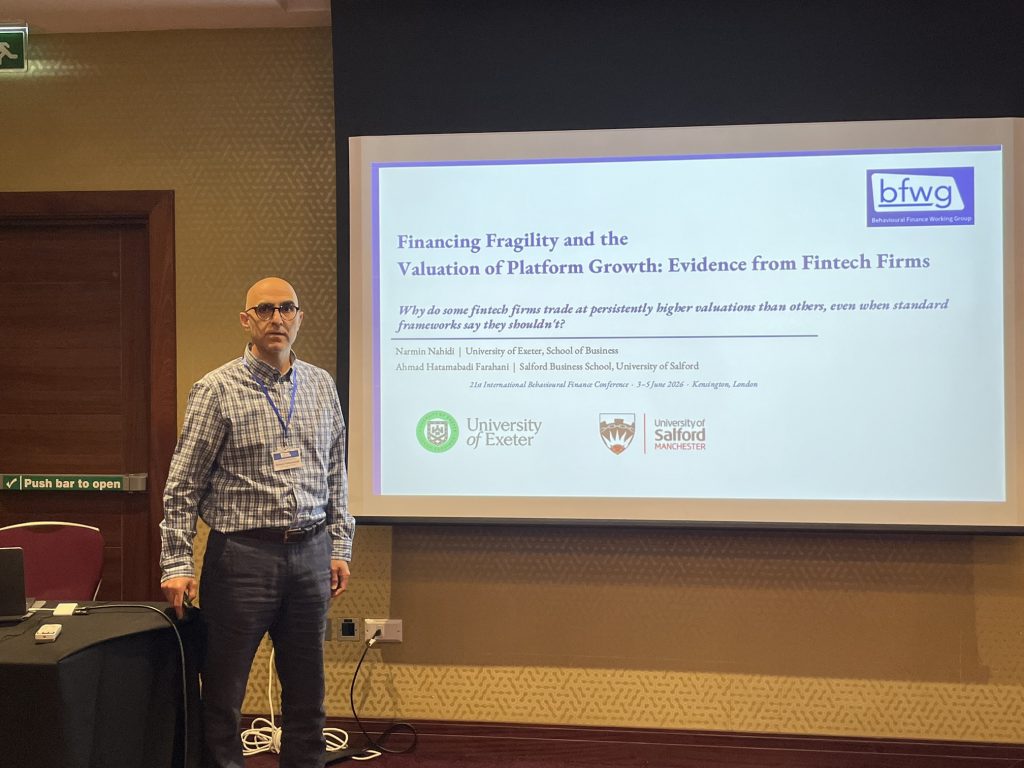
The 21st International Behavioural Finance Conference, held in London, brought together academics and researchers from 82 universities, across 21 countries and five continents, to discuss emerging developments in behavioural finance, financial markets, AI (artificial intelligence), fintech and digital decision-making.
Among the presentations was Salford Business School Lecturer in Accounting and Finance, Dr Ahmad Hatamabadi Farahani’s paper on, “Financing Fragility and the Valuation of Platform Growth: Evidence from Fintech Firms.” Co-authored with Dr Narmin Nahidi from the University of Exeter, the research explores how fintech firms that rely on algorithmic and data-driven information processing, are valued differently from more traditional relationship-based financial intermediaries.
Understanding valuation in digital financial markets
A key theme of the research is the relationship between platform growth, financing stability and enterprise value. The findings suggest that fintech firms using “hard-information” systems may achieve a valuation premium because they are better able to scale network effects through digitally processable data. However, this relationship weakens when financing conditions become unstable, as investors appear more cautious in interpreting growth signals during periods of fragility.
The study also highlights the role of sustainability performance in fintech valuation. While sustainability alignment can strengthen valuation efficiency at moderate levels of growth, the benefits become less pronounced as firms expand further. In addition, the research suggests that data-intensive investment may reduce short-term valuation efficiency while supporting longer-term scalability and platform development.
Behavioural finance, AI and financial decision-making
One of the strongest themes across the conference was the growing convergence between behavioural finance, artificial intelligence, digital information environments and platform-based business models. Discussions highlighted how behavioural finance continues to provide important insights into investor behaviour, particularly in environments characterised by uncertainty, rapid technological change and information asymmetry.